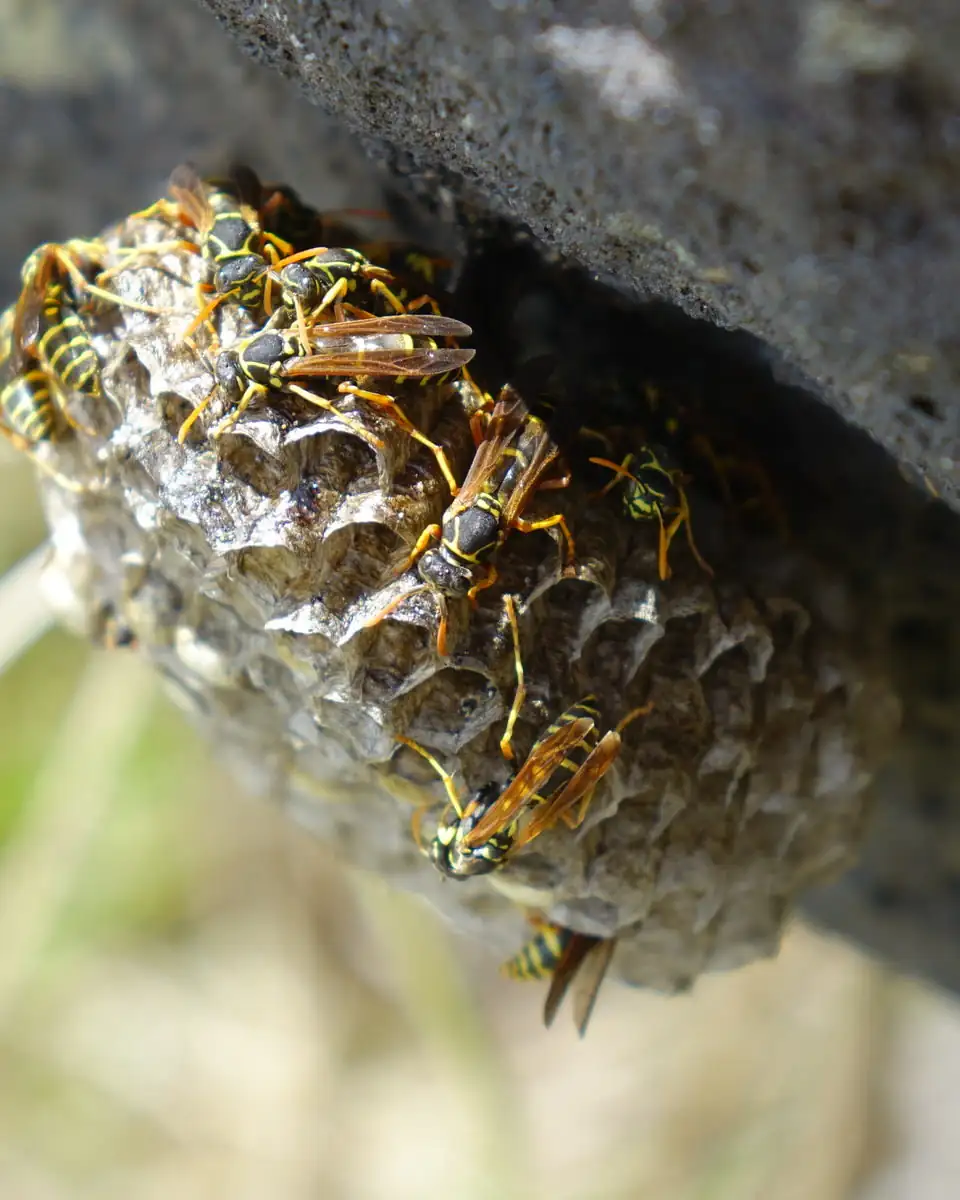
Waspari in one minuteWaspari is an Auckland wasp nest service. You tell us where the nest is, we arrange a local pest controller to look at it, and you get the price in writing before anything is touched. We cover the whole region as a mobile service, from Warkworth to Papakura. We also publish plain, sourced guides on wasps, stings and nests, because most wasp questions are safety questions.
Why only wasps?
Because wasp nests are seasonal, risky and easy to get wrong. A German wasp nest in a wall is a different job from a paper wasp comb in a hedge, and both are different from a honey bee swarm. Sticking to one problem means every page, every question we ask on the phone and every quote is about wasps. Nothing else competes for the call-back in February.
What we handle
- German and common wasp nests: ground, roof, wall and under-deck nests
- Asian and Australian paper wasp combs in hedges, eaves, fences and sheds
- Several nests on one property, including rural blocks
- Schools, cafes, body corporates and worksites
- Rentals, with the quote going to whoever pays
What we pass on, and to whom
Some things that look like wasp jobs are not. Honey bee swarms go to beekeepers: Honey and Bees New Zealand lists swarm collectors, and the Auckland Beekeepers Club collects open-air swarms. Bumblebee nests are usually left alone. A suspected yellow-legged hornet goes to MPI on 0800 80 99 66, untouched. Sting reactions go to Healthline on 0800 611 116, or 111 when breathing or swallowing is affected.
Why the nest is seen before the price is set
Two nests that look the same from the lawn can be very different jobs. One wasp hole in a bank may lead to a nest the size of a football a metre back. Wasps under a soffit may be nesting two metres along inside the roof. So the price is set at the property, in writing, and nothing is treated until you agree to it. Typical published Auckland prices run about $120 to $350 per nest, as our cost guide explains.
How a nest job runs
- You call or send the form with your suburb and where the wasps are.
- We call back, usually the same working day, and ask the safety questions first.
- A local pest controller visits, finds the entrance and works out how far the nest runs.
- You get the price in writing. You say yes or no.
- The nest is treated with a registered product, used to its label, often late in the day.
- You keep people and pets back until you are told it is clear.
The step-by-step version, including what happens to the dead nest, is on how it works.
The rules wasp work runs under
Insecticides sold and used in New Zealand must be approved under the Hazardous Substances and New Organisms Act 1996, and the label carries the conditions of use. That label is the rulebook for any product used at your place. Vespex bait for German and common wasps is sold only to registered approved users. Auckland Council treats wasps on its own land but not on private property. Exotic pests such as the yellow-legged hornet are a biosecurity matter for MPI.
- Hazardous Substances and New Organisms Act 1996: approved products, label conditions
- Biosecurity: suspected yellow-legged hornets reported to MPI, never disturbed
- Auckland Council: owners deal with pests on their own land; council treats its parks and reserves
- Rentals: Tenancy Services' guidance on pests for landlords and tenants
- Workplaces: a nest on a walkway or play area is a hazard to manage like any other
Where we go
Everywhere in the Auckland region: the isthmus, the North Shore and Hibiscus Coast, West Auckland and the Waitakere Ranges edge, East Auckland, South Auckland, and rural Rodney and Franklin. There is no shopfront or depot to visit. Every visit happens at your property. Where we go has notes on local wasp conditions in each part of Auckland.
How our wasp guides are written
Every guide starts from New Zealand sources: the Department of Conservation, Manaaki Whenua Landcare Research, MPI, the University of Auckland, Health New Zealand, Healthify, St John and KidsHealth. Each page lists the sources checked and the date it was last reviewed. Health pages give first aid and when to get help, never doses. If you spot a mistake, email [email protected] and we will check it and fix it.
What you won't find on this site
No star ratings, testimonials, staff photos, award badges or photos claimed as our jobs. We don't publish what we can't stand behind. The photos are real, credited Creative Commons pictures of wasps and places, mostly taken in Auckland by naturalists on iNaturalist and Wikimedia Commons. Each caption says what it shows and where, and the credit sits under it.
Who does the work
The pest controller who quotes and treats the nest runs an independent Auckland pest control business that we work with. Your request goes to them and nobody else. Your agreement for the job, and any follow-up they offer, is with them. The terms and privacy policy set this out.
The full picture of nests, prices and visits is on the Waspari front page.
Questions people ask
Is Waspari a pest control company?
Waspari is a wasp nest service. We take your request, ask the questions that matter, and arrange an independent local pest control business to quote and do the job. That business is responsible for the work itself.
Do you remove bees?
No. Honey bees are not treated as pests. Swarms go to beekeepers, many of whom collect them free, and bumblebee nests are usually left alone. If you are not sure what you have, our bees vs wasps guide shows the differences.
How do I correct something on a guide?
Email [email protected] with the page and what looks wrong. We check it against the sources and update the page and its review date.
Sources we checked
- Wasps (Department of Conservation)
- Wasp control (Manaaki Whenua Landcare Research)
- Vespex FAQ (Merchento)
- How to control pest animals (Auckland Council)
- Yellow-legged hornet (Department of Conservation)
- Swarm collection (Honey and Bees New Zealand)
- Report a swarm (Auckland Beekeepers Club)
- Pests and infestations (Tenancy Services)
- Healthline 0800 611 116 (Healthpoint)
Last reviewed 2026-11-05.