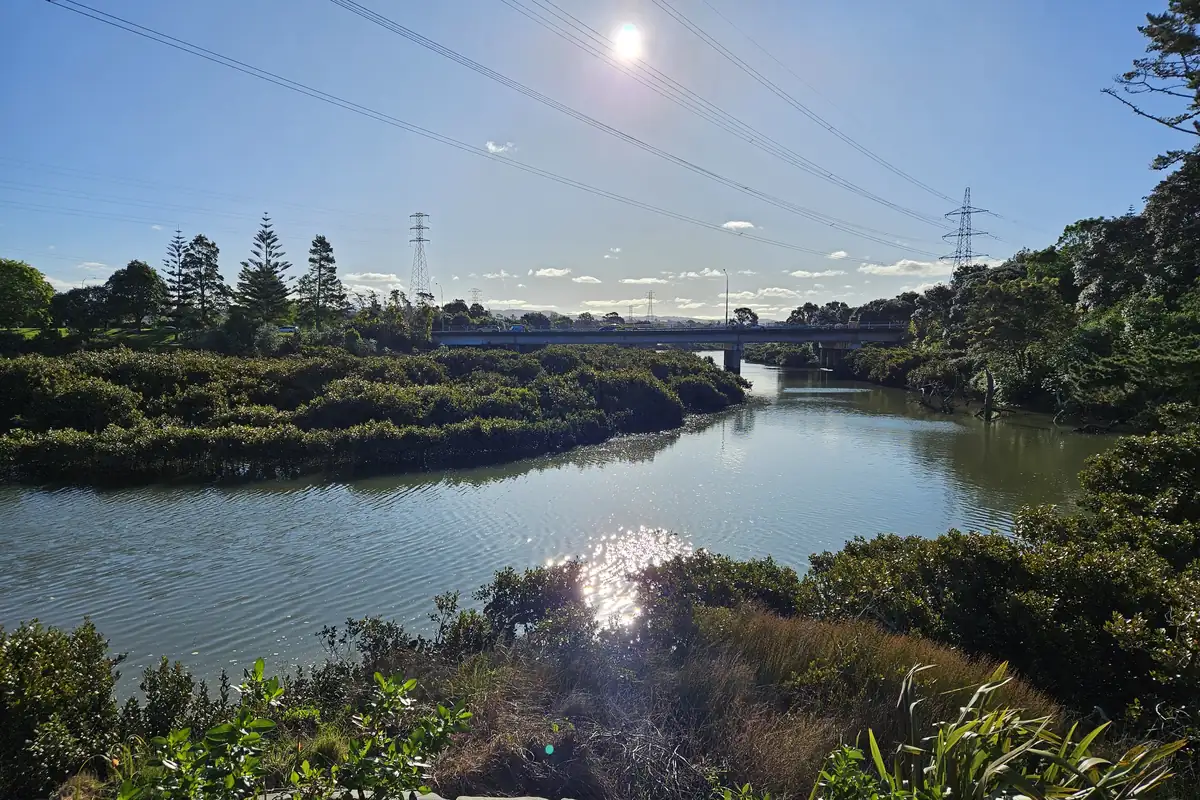

Straight answerNew Lynn, Avondale and Kelston sit on both sides of the Whau River, where the isthmus is at its narrowest. The land is clay, which fed a brick and pottery industry for over a century. Today it is a mix of family homes, school grounds, parks and new apartments near the station. German wasps dig into the clay banks, and paper wasps build on fences, balconies and eaves.
Clay country along the Whau
The Whau catchment is clay, sandstone and mud. The first brickworks opened on the river at Rosebank in 1852, and 23 of West Auckland's 39 brick and clay works sat along the Whau. The Ambrico kiln and Crown Lynn potteries made New Lynn famous until the works closed in 1989. Te Toi Uku, the clayworks museum, opened in 2015. For wasps, that clay matters. Cut banks and old fill dry hard in summer and are easy to tunnel.
Busy food courts and outdoor seating around LynnMall, which opened in 1963, draw foraging wasps in late summer. Those wasps can come from a nest several streets away.
Clay also shrinks as it dries, opening cracks along paths, steps and foundations. Wasps use those cracks as ready-made entrances.
The river edge and Te Whau Pathway
The Whau is an estuary, not really a river, running about 5.7 kilometres north to the Waitemata. Its intertidal banks are mostly mangroves and weeds. Te Whau Pathway, started in 2015, runs along its western edge toward Olympic Park. Sections that drop down to the mangroves often have a ground nest in the bank above the high tide line. Check the bottom of the garden in October, when nests are still small.
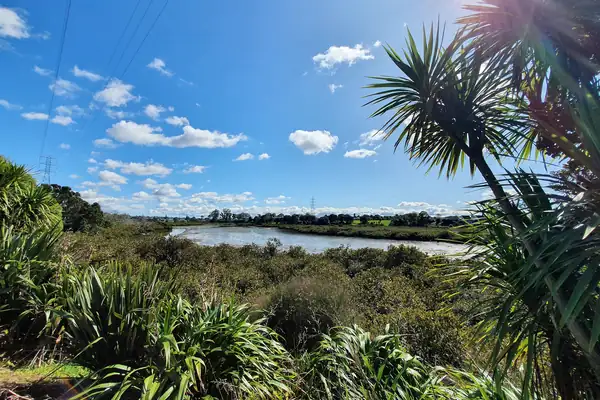

The Whau was a working waterway. By 1865 New Lynn had five public wharves, and boats carried bricks, leather and firewood. The last commercial cargo left the port in 1948.
If the nest is on reserve land along the river, report it to Auckland Council on 09 301 0101. Inside your boundary, it is yours to arrange.
Tidal creeks into the streets
The tide reaches further inland than many people expect. It runs up the Wairau Creek as far as Sabulite Road in Kelston. On the New Lynn side it reaches Clark Street and Wolverton Road along the Rewarewa Creek. Homes on those creeks back onto mangroves, reserve planting and clay banks. That suits German wasps, which like a dry, sunny bank close to food. Check the top of the bank, under any retaining wall and beneath garden sheds. A nest found in October is small and simple. One left until March can be as big as a bucket.
Apartments and terraces near the station
Since 2010 New Lynn has been rebuilt around its station, which now runs in a trench under the town centre. Medium and high density housing followed, including the Merchant Quarter Apartments in 2015. Avondale has also added new apartments and terraces. Balconies, planter boxes and podium gardens get paper wasp combs. On common property, the body corporate usually books the visit. Body corporate and commercial visits explains the process.
In Avondale, the Highbury Triangle is a purpose-built Kainga Ora complex mainly for older residents. People living there should report a nest to the housing manager rather than tackle it themselves.
Newer terraces often have small, walled courtyards. A nest under a deck or in a planter there can sit right beside the back door.
Olympic Park, Manawa Wetland and the streams
Olympic Park opened as the New Lynn Domain in 1918 and was redeveloped in 2007. The Avondale Stream runs through it. Manawa Wetland was made from an old clay quarry. Planted stream banks, wetland edges and sports grounds attract foraging wasps in late summer. Families using the playgrounds and paths should watch for wasps flying low into the grass.
- RiverWhau estuary, about 5.7 km
- GroundClay, sandstone and mud
- HousingHomes plus new apartments
- Watch forClay bank and balcony nests
Avondale: racecourse, markets and Rosebank
Avondale sits on the eastern shore of the Whau. Its racecourse hosts the Avondale Sunday markets, the largest in the country, and sports fields fill the infield. The Rosebank Peninsula was once market gardens. Food stalls, fruit and bins bring wasps in numbers once nests peak in late summer. Stallholders with a nest under a trailer or shed can book a visit like anyone else.
Avondale also has a long market-garden past. The Hayward kiwifruit was developed on the Rosebank Peninsula, and Chinese growers farmed land in the district. Home vegetable plots and fruit trees still draw wasps in autumn, when ripe fruit is easy sugar.
Kelston schools and big grounds
Kelston is mostly residential, with a cluster of schools. Kelston Boys' High, Kelston Girls' College, Kelston Intermediate and the Kelston Deaf Education Centre all have large grounds. Avondale College, one of the country's largest high schools, is just across the river. Banks along fields and gardens near classrooms are common nest sites. Schools can book through the commercial page.
Kelston was a clayworks area too, with an Archibald Brothers clay and pottery yard on the western shore of the Whau. Today the streets are mostly houses, which means lawns, sheds and fences rather than kilns.
Check banks and the gaps under prefab classrooms in late January, before students come back.
What a visit costs in New Lynn
Most nests in the Whau area fall within the guide range of about $120 to $350 per nest. An open paper wasp comb on a fence or balcony is usually at the lower end. A German wasp nest in a clay bank, under a deck or inside a wall costs more. Those are guide figures only. The pest controller gives you a written quote after seeing the nest, and that is your price. Cost guide.
Booking in New Lynn, Avondale and Kelston
Tell us the street, where the wasps go in, and whether you are in an apartment or a house. If the nest is under decking, nests under decks explains what to avoid. A local pest controller comes to you, and we'll arrange the visit. Apartment residents should mention the floor, lift access and visitor parking. Use the quote form or call 09 942 7069.
Every other suburb is covered as well. Go back to Waspari's Auckland nest visits for prices, timing and the booking steps.
Questions people ask
There's a nest in the bank above the Whau mangroves. Who deals with it?
If the bank is council reserve, report it to Auckland Council on 09 301 0101. If it is inside your boundary, it is yours to arrange, and we can book the visit.
Our apartment balcony has a paper wasp nest. Who books the visit?
A nest on your own balcony is usually yours or your landlord's to arrange. On shared areas, ask the body corporate or building manager to book it.
Do you cover Glen Eden, Blockhouse Bay and Rosebank too?
Yes. We take requests from New Lynn, Avondale, Kelston and the surrounding West Auckland suburbs.
Sources we checked
- New Lynn (Wikipedia)
- Whau River (Wikipedia)
- Avondale (Wikipedia)
- Kelston (Wikipedia)
- How to control pest animals (Auckland Council)
Last reviewed 2026-11-05.