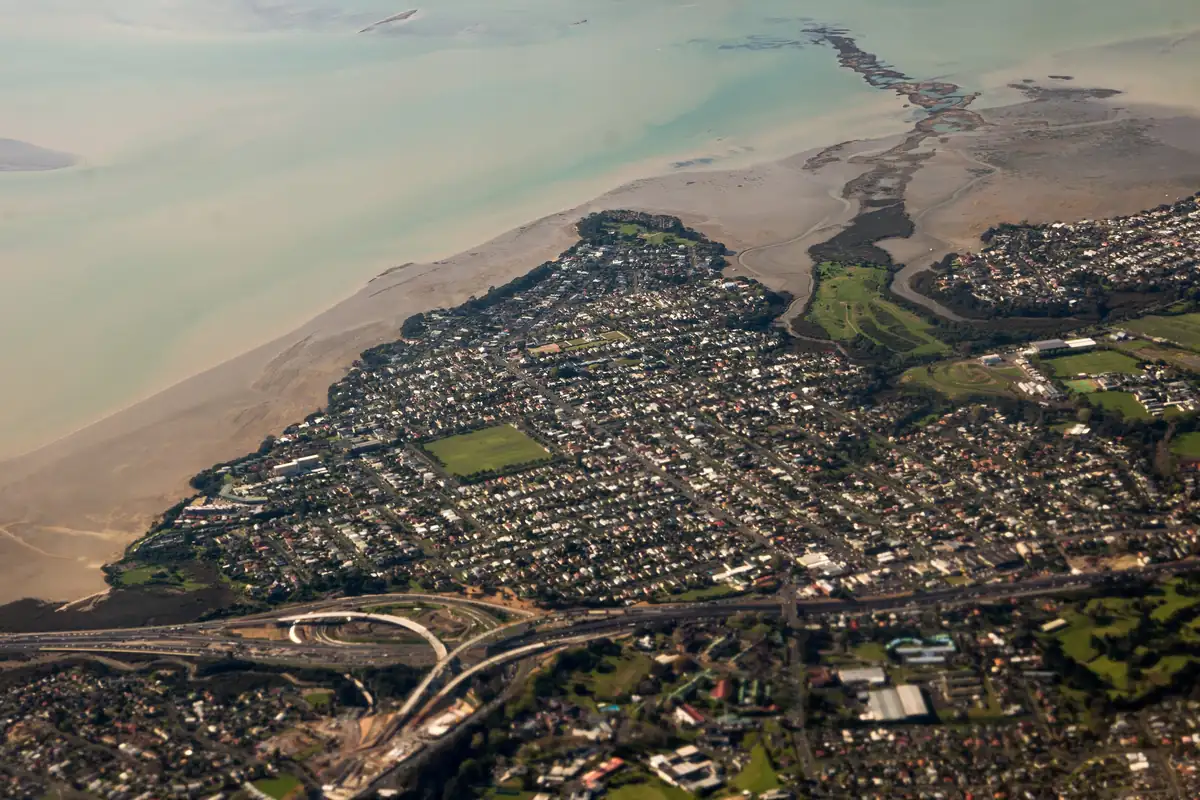

Straight answerPoint Chevalier and Westmere are neighbouring peninsulas on the Waitemata Harbour, with Meola Reef between them. Streets of 1920s bungalows and 1930s Art Deco homes run down to beaches, reserves and mangrove creeks. Summer crowds, picnic food and old reclaimed ground all shape where wasps turn up. Paper wasps are common on eaves and fences, and German wasps dig into the clay.
A clay peninsula, not volcanic soil
Point Chevalier sits on a triangular peninsula that runs about 1,800 metres into the harbour. Unlike much of the isthmus, its soil is mostly clay with no volcanic layer over it. Clay banks cut for driveways, retaining walls and back lawns dry hard in summer. German wasps dig into them easily. A neat hole in a sunny bank with steady traffic is the sign. Ground nests explains the rest.
The clay also means planting is less lush than on the volcanic suburbs nearby. Open, sunny lawns and bare banks are exactly what a nesting queen looks for in spring.
Bungalows and Art Deco houses
Most houses here are 1920s Californian bungalows and Art Deco homes from the 1930s and 1940s. Toward the tip of the peninsula there are more post-war houses, plus newer architect homes near the beach. Bungalows have wide eaves and timber subfloors. Art Deco homes often have low roofs behind parapets, where gaps at flashings let wasps in. Paper wasps favour sheltered eaves facing the sun.
Point Chevalier was an army camp in the 1860s and stayed largely rural until between the wars. That means few houses here are much older than a century, but many are close to it.
The Liverpool Estate, laid out in 1913 near Great North Road, named its streets after native birds: Moa, Huia and Kiwi Roads and Tui Street. Those streets are among the older parts of the suburb, so check timber joins and roof vents there each spring.
Coyle Park and the beach
Coyle Park sits at the northern tip of the peninsula. It is a former landfill site, now a park and nature reserve. Point Chevalier Beach was resanded in 2008 with 16,000 cubic metres of sand. Since then it has drawn big crowds on fine weekends. Picnics, barbecues and open bins draw foraging wasps from February. Those wasps may come from a nest in a nearby garden, not the park itself.
Between the wars, trams ran down Point Chevalier Road to Coyle Park, and summer trams carried families to the beach. The crowds are back now, and the bins fill fast on a hot day.
Meola Reef reserve and dog walks
Meola Reef is an old lava flow that runs more than 2 kilometres into the harbour. The near-shore part is covered in mangroves. The old city tip beside it was capped and turned into a 15 hectare reserve, with native planting since the 1990s. Much of it is now a fenced off-leash dog park. Dogs that nose into long grass find ground nests first. Read dog stung by a wasp before summer.
Meola Creek and the streams by the reef have mangrove swamps and tidal salt marsh on either side. Wasps rarely nest in wet mud, but the dry fill and planted banks above them suit ground nests.
- PeninsulaAbout 1.8 km into the harbour
- SoilClay, no volcanic layer
- Housing1920s bungalows, Art Deco
- Watch forClay bank and eave nests
Westmere and Coxs Bay
Westmere is a former peninsula on the far side of the reef, named with the 1923 Westmere Estate. Most of its first homes were bungalows for workers and tradespeople, and state houses followed in the late 1930s. Coxs Creek and its causeway shaped the bay. Parts of the shoreline sit on old landfill. Garnet Road runs along the ridge, so many sections slope down toward the water. Sloping back gardens with dry banks suit ground nests.
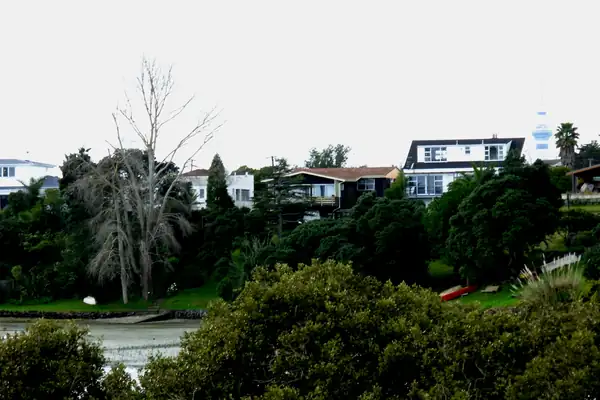

More streets went on sale in 1925 and 1926, so many Westmere homes are close to a hundred years old. Timber of that age opens up at window frames, base boards and roof edges, and wasps find those gaps.
Infill, renovations and new builds
Rising values have led to subdivision, especially north of Meola Road and near the water. New townhouses and renovated bungalows change where wasps nest. Opened walls, stacked timber and fresh retaining walls give new gaps. Builders working on a renovation sometimes find a nest inside a wall. If that happens, stop work on that wall and read wall nests before going further.
Townhouse sites often leave bare clay batters and timber stacks in place for months. Builders should look for wasp traffic before shifting stacked materials in late summer.
Paper wasps on sunny eaves
Asian paper wasps were first recorded in Auckland in 1979 and spread into inner and western suburbs from 1984. On these peninsulas they are now a familiar sight. Their nests are open grey combs hanging from a short stalk under eaves, pergolas, fence rails and dense shrubs. Colonies stay in the hundreds, not thousands. They are usually less aggressive than German wasps, but they sting hard when a comb is knocked. Hedge trimming and pegging out washing cause most stings. Look before you clip. See paper wasp nests for what a visit involves.
Prices on the point
Most nests in Point Chevalier and Westmere come in within the guide range of about $120 to $350 per nest. An open paper wasp comb on an eave is usually toward the lower end. A German wasp nest in a clay bank or inside a parapet roof is usually higher. These are guide figures. The pest controller gives you a written quote, and that sets the price. See the cost guide for what changes it.
Booking in Point Chevalier
Weekend beach traffic can make parking slow near the water, so tell us about access when you book. Let us know the street, where the wasps go in, and whether the nest is near a reserve. A local pest controller comes to you, and we'll arrange a time. If the nest is on a shared boundary, tell your neighbour first. Use the quote form or call 09 942 7069.
Every other suburb is covered as well. Go back to Waspari for prices, timing and the booking steps.
Questions people ask
Wasps keep finding our picnic at Coyle Park. Is there a nest nearby?
Not always. Foraging wasps fly a long way for food, so they may come from gardens nearby. A nest on council parkland is for Auckland Council to deal with; report it on 09 301 0101.
Our dog was stung at the Meola Reef dog park. What should we do?
Move the dog away from the area and watch it closely. Call your vet straight away if the face or throat swells or the dog struggles to breathe.
Do you cover Grey Lynn, Herne Bay and Waterview too?
Yes. We take requests from Point Chevalier, Westmere and all the nearby western bays.
Sources we checked
- Point Chevalier (Wikipedia)
- Westmere (Wikipedia)
- Meola Reef (Wikipedia)
- How to control pest animals (Auckland Council)
- Vespula wasps (Manaaki Whenua Landcare Research)
Last reviewed 2026-11-05.