
Straight answerDrive south from Botany Downs to Ormiston and you pass through forty years of building. Botany Downs is 1970s. Dannemora is 1990s and early 2000s. Flat Bush and Ormiston are mostly the 2000s and 2010s. Each era leaves different gaps for wasps. Streams, ponds and reserves run between them, and the farmland of Whitford starts at Mangemangeroa Creek.
From farm names to suburbs
Botany Downs takes its name from a farm leased by Vern Carr in the 1950s and 1960s. Housing arrived in the mid-1970s, and Botany Downs Primary School opened in 1975. Dannemora was developed in the 1990s and early 2000s, and was named after the developer's horse stud in Christchurch. When Point View School opened in 1997, it was still surrounded by farmland.
Flat Bush was named for the kahikatea forest that once covered the flats. The land became dairy farms. Manukau City Council bought 290 hectares in 1996, and building started in the Chapel Park subdivision in 1998. By the 2023 census Flat Bush held over 45,000 people, up 40 percent in five years.
Before the houses, East Tamaki was farmed mainly by Scottish and Irish settlers. They grew potatoes, oats and wheat, then turned to dairying around 1900. A few old farm trees, hedges and shelter belts survive between the estates and in the reserves. Willowbank Cottage, the oldest remaining house in East Tamaki, gave Willowbank School its name. Old trees and hedge lines are where German wasps often nest on the edge of new suburbs.
Which homes get which wasps
The 1970s homes in Botany Downs now have tired soffits and loose ridge tiles. There are often gaps where additions meet the old walls. German wasps use those gaps to reach ceiling spaces and wall cavities. Some homes built around 2000 were part of the leaky homes crisis, including the 153-unit Sacramento development. Cracked cladding and gaps around window joinery let wasps in as well as water. Wall cavity nests.
Newer Flat Bush and Ormiston houses are tighter. Here the usual find is an Asian paper wasp comb under eaves, on a pergola or behind a downpipe. German wasps still nest in the ground, in raised beds, under paving edges and in retaining walls.
- 1970s Botany Downs homes: roof and wall nests
- Around 2000: cladding cracks and joinery gaps
- Flat Bush and Ormiston: paper wasp combs on eaves and pergolas
- Stream banks and reserve edges: German wasp ground nests
Barry Curtis Park and the green fingers
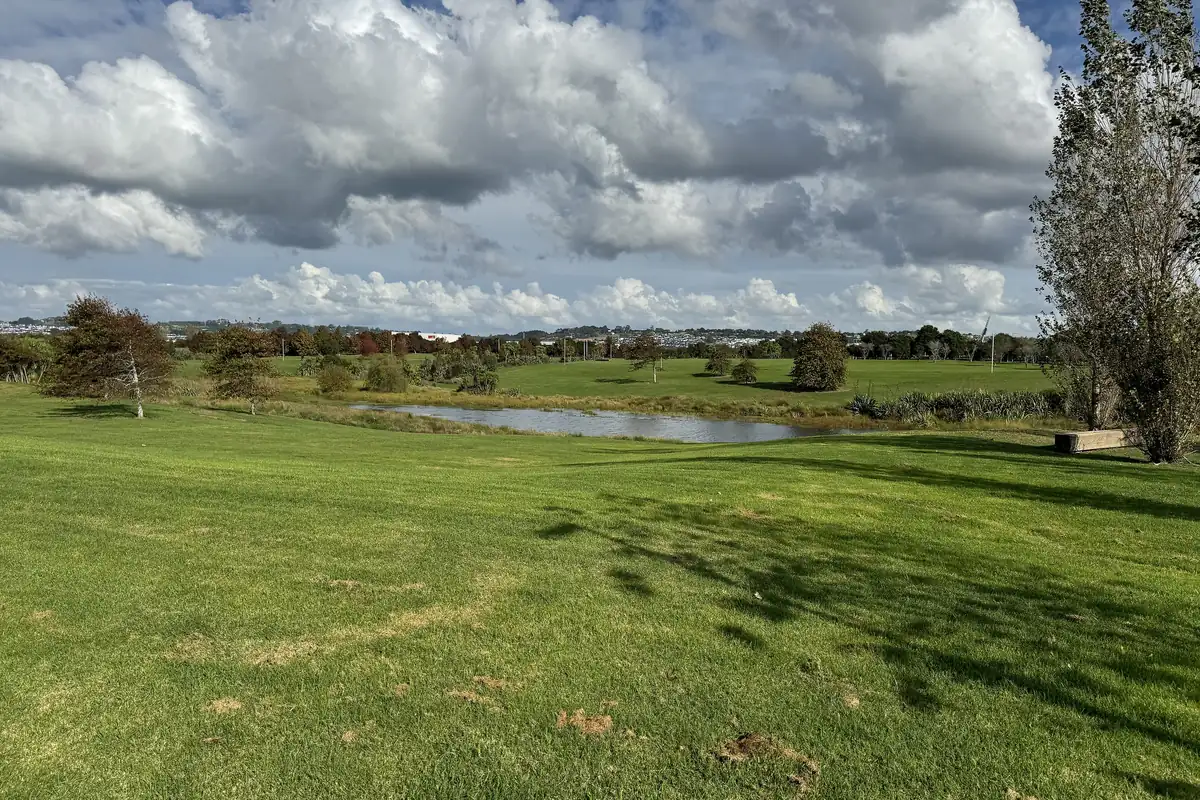
Barry Curtis Park is 94 hectares, one of the largest parks in New Zealand. Its first stage opened in April 2009. It sits at the centre of a planned network of parks along about 45 kilometres of streams draining the Flat Bush catchment. The ponds double as stormwater wetlands.
Those long green corridors run behind thousands of houses. Sunny, dry stream banks suit German wasp ground nests, and the planting feeds foragers. Murphy's Bush, a remnant forest reserve in Flat Bush, adds older trees. Nests in the parks and reserves go to Auckland Council on 09 301 0101.
- Built1970s to 2010s
- Barry Curtis Park94 ha, opened 2009
- Highest pointPoint View, 142 m
- SoilClay and sandstone
Clay banks and ground nests
The soil around Howick and Botany is mostly clay and sandstone. Cut banks behind newer houses dry hard in summer and crack, and old rodent holes and root gaps give queens a start. A ground nest shows as a single hole with wasps flying straight in and out. Don't block the hole or pour anything in. Ground nests.
Dannemora rises to Point View, a 142-metre hill that was once a defended Ngai Tai pa. Streets on its slopes have steep driveways, terraced gardens and tall retaining walls. Gaps behind timber walls and drainage holes in block walls make good nest entrances. If wasps are using one, keep people off the steps below it until it is treated.
Mangemangeroa and the rural edge
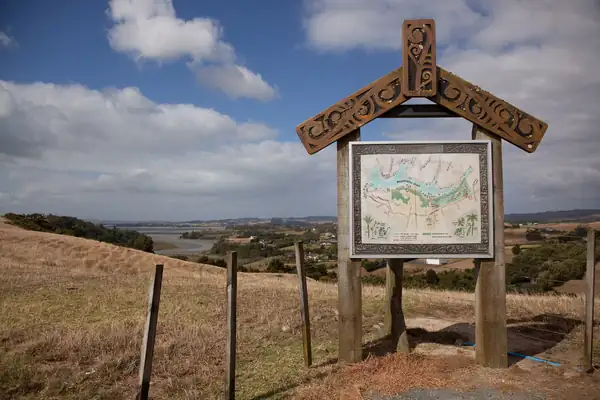
Mangemangeroa Creek forms the border between suburban East Auckland and the countryside around Whitford. It is a drowned valley that becomes a tidal estuary, with totara, nikau, karaka and puriri close to the water. Mangemangeroa Reserve opened in 2000, and a track runs from Shelly Park. Homes on this edge can expect wasps from the bush and nests in sheds, trees and banks. Walkers on the track meet ground nests in sunny spots beside the path in late summer. Report those to the council.

Schools, temples and town centres
This area has some of Auckland's biggest schools. Botany Downs Secondary College has close to 2,000 students, and the Ormiston colleges and Sancta Maria College add thousands more. Fo Guang Shan, the largest Buddhist temple in New Zealand, opened in Flat Bush in 2007, and Ormiston Town Centre in 2021. Grounds like these have hedges, gardens and outdoor seating. A visit can be booked out of hours. Commercial sites.
Townhouses and shared walls
If you live in a terrace or townhouse block, a nest in one unit's roof can spread wasps into the next unit. Where the nest is on common property, the body corporate usually arranges the job. Tell us the complex name and who manages it when you book. Rentals and shared buildings.
A price guide for East Auckland nests
A single nest normally sits inside the published Auckland range of about $120 to $350. A paper wasp comb on a single-storey eave is at the low end. A two-storey roof, a wall cavity or a nest deep in a bank takes longer. Treat these numbers as a guide. The pest controller puts your price in writing first. Cost guide.
Sending us the details
Give us the street, the type of house and where the wasps go in. Say if you share walls or a driveway. If the nest is in a shared fence or a reserve bank, say that too. It changes who arranges the job. A photo of the entrance, taken from a safe distance, also helps with the price. A local pest controller comes to you and quotes before any work. Quote page.
Every other suburb is covered as well. Go back to Waspari's Auckland nest visits for prices, timing and the booking steps.
Questions people ask
Who handles a wasp nest in Barry Curtis Park or along the stream paths?
Parks, stream reserves and walkways are council land. Report the nest to Auckland Council on 09 301 0101.
There is a comb on our townhouse complex's shared fence. Who arranges it?
Usually the body corporate or its manager, because the fence is common property. Let them know first.
Do you cover Ormiston, Shamrock Park and East Tamaki Heights?
Yes. We cover all of Botany, Flat Bush and Dannemora, and the rest of East Auckland.
Sources we checked
- Botany Downs (Wikipedia)
- Flat Bush (Wikipedia)
- Dannemora (Wikipedia)
- Barry Curtis Park (Wikipedia)
- Mangemangeroa Creek (Wikipedia)
Last reviewed 2026-11-05.