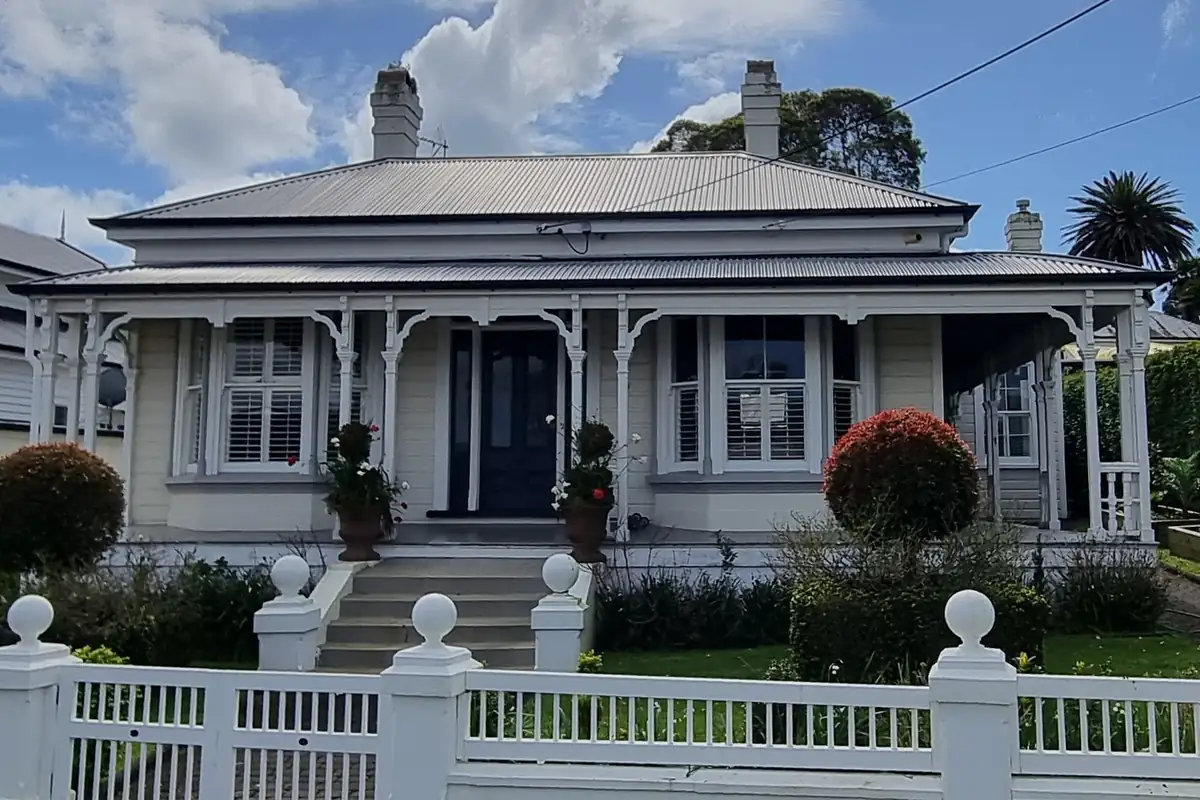

Straight answerDevonport is the oldest colonial settlement on the North Shore, and its housing shows it. Many streets are lined with timber villas, some from the 1800s. German wasps find their way into those roof spaces and subfloors. Paper wasps hang small grey combs under verandahs and in clipped hedges. The volcanic cones, beaches and reserves give both kinds sun, water and plenty of food.
A settlement older than most of Auckland
The first permanent settlers lived beside a signal station on Mount Victoria from 1841. The village was called Flagstaff until it was renamed Devonport by 1859. Town sections were subdivided in the early 1850s, and Devonport became a borough in 1886. In 2007 the regional council agreed its wharf area was too much in character to be a growth node. So the old houses mostly stayed.
In Cheltenham, the eastern end of Devonport, several landmark homes date from 1896 to 1907. Jubilee Avenue and Cheltenham Road have good examples. Houses of that age have had a century of small repairs, and every patch leaves a seam that a wasp can use.
Villa roofs, verandahs and subfloors
A typical villa has a corrugated iron roof, a timber ceiling space and boxed eaves. German wasps get in where the iron meets the barge boards, or through a gap behind the gutter. Inside, the nest grows unseen until late summer. You usually notice a steady line of wasps at one spot on the roof edge. Roof nests explains what to look for and why you should not block the hole.
Villas also sit on piles with a ventilated subfloor. Wasps use the vents and broken base boards to reach dry soil under the house. Decks and verandahs added later create more dark, sheltered space. If the wasps go under the boards, read nests under decks before you lift anything.
A quick spring check pays off on an old house. DOC suggests looking on sunny days near dawn or dusk, when low light shows the wasps' flight path. Walk round the eaves, the verandah and the base boards. A queen with a few workers in October is a small job. The same nest in March can hold thousands.
Takarunga, Maungauika and the grassy slopes
Devonport has three volcanoes of the Auckland volcanic field. Takarunga / Mount Victoria and Maungauika / North Head still stand. Takararo / Mount Cambria was quarried away in the 1870s. Both remaining cones have open grass, old gun pits, bunkers and tunnels from the coastal defence years.
Sunny, well drained scoria and grass banks suit ground-nesting German wasps. A busy hole beside a path is often the first sign. Both cones are Tupuna Maunga, ancestral mountains managed by Auckland Council under the Tupuna Maunga Authority. Do not dig or spray there. Report the spot to the council and keep children and dogs clear. See ground nests for the signs.
Mount Victoria's slopes also hold Devonport Primary School, a playcentre, a cemetery and a reservoir. Homes that back onto those slopes get foraging wasps along the fence line from midsummer.
- Oldest streetsSubdivided early 1850s
- ConesMount Victoria, North Head
- Common findVilla roof and subfloor nests
- On the maungaReport to Auckland Council
Beaches, reserves and old fig trees
The suburb has three beaches: Devonport Beach and Duders Beach on the harbour, and Cheltenham Beach facing the Rangitoto Channel. Windsor Reserve and King Edward Parade sit near the wharf, with big Moreton Bay fig trees by the library. Picnic food, bins and sweet drinks draw wasps here from February.
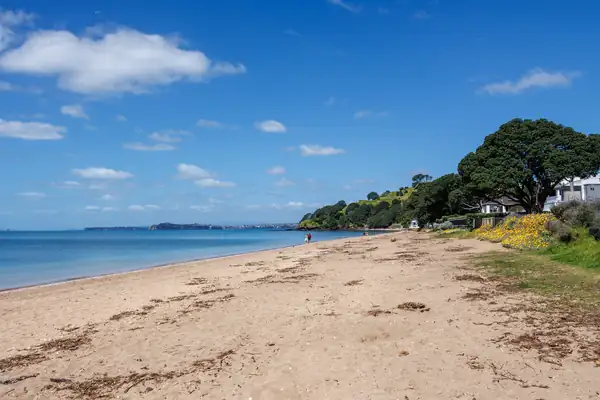

Large old trees can hide a nest in a hollow or a thick tangle of branches. Paper wasps also like hedges and climbers on garden walls. If wasps keep going in and out of one tree on your section, nests in trees covers what to do next.
The golf course and Ngataringa Bay edge
Devonport was once nearly an island. Only a thin strip of land at Narrow Neck joined it to Belmont. In the late 1800s the mangrove swamp from Narrow Neck to Ngataringa Bay was filled for a racecourse. That land is now a golf course, with the bay's mangrove edge to the west.
Rough grass, bunker banks and tree lines on reclaimed ground suit ground nests. Homes along the edge get wasps foraging over the fence. A nest on club land is the club's to arrange, so tell the club office.
Stanley Point and the naval base
Stanley Point, called Stanley Bay until 2007, is a small and mostly residential suburb west of Devonport. The Devonport Naval Base has been in use since 1841, and its Calliope Dock opened in 1888. A tunnel links the base to storage on the Ngataringa Bay side. Stanley Bay School has stood here since 1909.
A nest inside the base fence is a matter for the base itself. We take requests for private homes, rentals and local businesses outside it. If your back fence meets base land, tell us so the technician knows where the boundary sits.
Cafes, the wharf and the village shops
Between the ferry wharf and Mount Victoria sit cafes, the 1912 Victoria Theatre and the 1930s former post office. Outdoor tables and courtyard planters are classic late-summer wasp spots. A nest in a shopfront verandah or a rear service lane needs a visit timed around opening hours. Commercial visits explains how that works for shops and cafes.
What a Devonport wasp visit costs
Most nests on the peninsula fall inside the Auckland guide range of about $120 to $350 per nest. A paper wasp comb under a verandah sits near the bottom. A German wasp nest deep in a villa roof or subfloor sits higher, because access takes longer. These figures are a guide only. The written quote from the pest controller sets the price before any work starts. More detail is in the cost guide.
Booking a visit on the peninsula
Tell us the street, where the wasps fly in, and whether the house is a villa or newer. Mention where the technician can park and any locked gate. A local technician comes to you, usually the same day or the next in summer. For a quote, use the form on the quote page or call 09 942 7069. Further north, see Takapuna and Milford.
Every other suburb is covered as well. Go back to Waspari's Auckland nest visits for prices, timing and the booking steps.
Questions people ask
There is a wasp nest on Mount Victoria. Can I deal with it myself?
No. Mount Victoria and North Head are Tupuna Maunga managed by Auckland Council under the Tupuna Maunga Authority. Leave the nest alone, keep people clear, and report its location to the council.
Our villa is a listed heritage house. Will a nest visit damage it?
Most nest jobs work through the gap the wasps already use, so no boards need to come off. If access means lifting anything, the technician will explain why and ask you first.
Do you cover Stanley Point, Narrow Neck, Vauxhall and Belmont?
Yes. We take requests from the whole Devonport peninsula and the rest of the North Shore.
Sources we checked
- Devonport (Wikipedia)
- North Head (Wikipedia)
- Mount Victoria (Wikipedia)
- Stanley Point (Wikipedia)
- Wasps (Department of Conservation)
Last reviewed 2026-11-05.