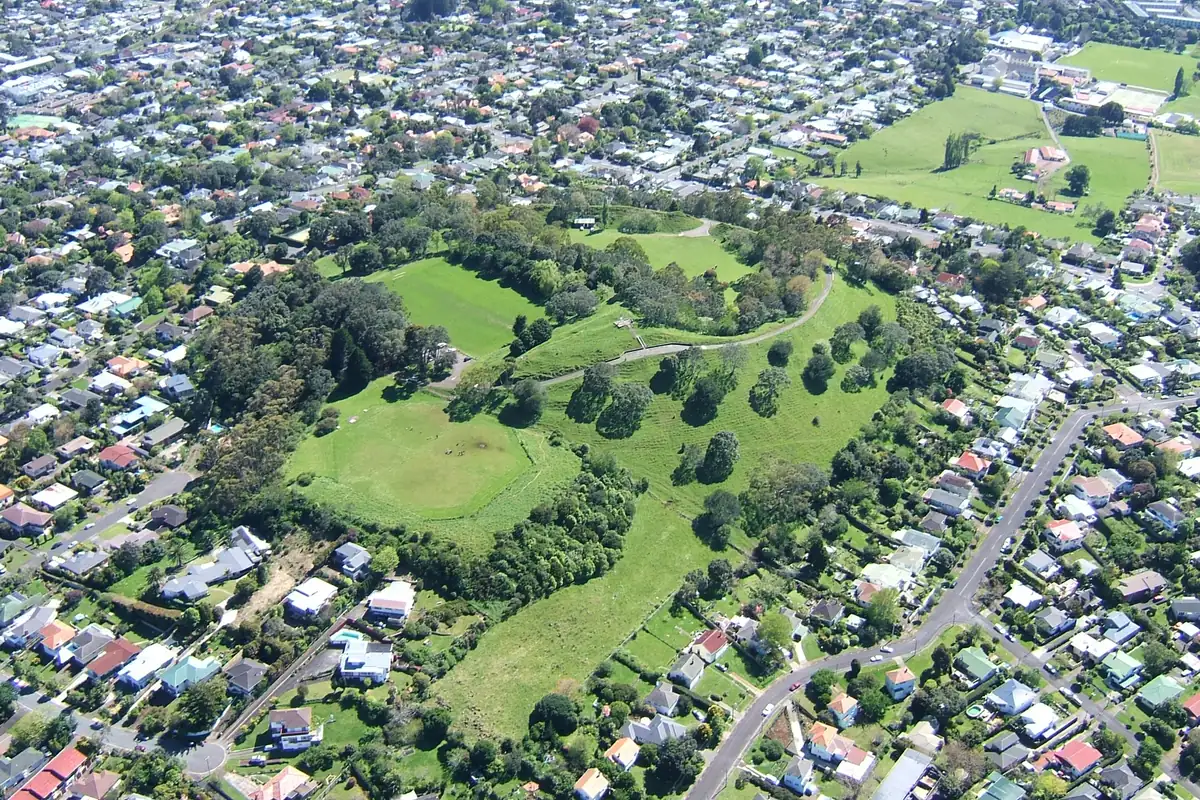

Straight answerMount Albert is built around Owairaka, a volcano that erupted about 120,000 years ago. Sandringham sits to the east on old swampland, with rows of bungalows either side of Sandringham Road. Oakley Creek forms the western edge, lined with planted bush. That mix of timber homes, playing fields and creek banks gives German wasps and paper wasps plenty to work with.
Owairaka: a cone that was quarried
Quarrying cut the cone down by about 15 metres, and it now stands about 135 metres high. Quarrying stopped in 1928. One crater was levelled for a playing field, and the other became a water reservoir in 1945. The old quarry pit became an archery field in 1961. Like Maungawhau, it is a Tupuna Maunga, and the summit road closed to most vehicles in 2019.
Grass banks, trees and sunny slopes around the maunga suit foraging wasps. Houses on the streets at its base often get ground nests in their own back banks. A nest on the maunga is for Auckland Council to manage, so report it on 09 301 0101 and keep people away.
Owairaka was once a large pa, with terraces and trenches dug by hand over generations. Those earthworks are part of what the maunga protects, which is one more reason to leave any nest there to the council.
From country estates to bungalow streets
Mount Albert grew fast once trams arrived on New North Road in 1915. Between 1901 and 1931 the population rose from about 2,000 to 20,600, making it New Zealand's largest borough. Most streets filled with timber bungalows, and state housing such as the Stewart Estate followed after the Second World War. Bungalow roofs have wide eaves, where paper wasps build, and subfloors that German wasps use. Paper wasp nests are usually the easier job.

Bungalows from this era often have lean-to additions and enclosed back porches. The join between the old and new roof lines is a common way in for German wasps, so check it each spring.
Sandringham: bungalows on a swamp
Sandringham began as Cabbage Tree Swamp, and floods slowed its growth for decades. Eden Park and Gribblehirst Park became lakes in heavy winter rain. Building took off around 1925, when the tramline came, and evenly spaced streets of Californian bungalows followed. Low, damp ground is not where German wasps like to dig. Here they favour roof spaces, wall voids and drier raised beds instead.
Sandringham Village is a nearly intact interwar shopping street with Art Deco touches. Its cafes and restaurants get wasps around outdoor tables and rubbish areas in late summer. Food businesses can book a visit through the commercial page.
If you hear scratching or humming inside a wall, read wasp nest in a wall before drilling or filling any hole. Blocking the entrance can push the wasps indoors.
Oakley Creek and the Unitec grounds
Oakley Creek, Te Auaunga, has the only natural waterfall on the isthmus. Much of its catchment became native bush reserve and parkland during the Waterview Connection works. Te Piringa bridge has joined Waterview and Mount Albert since 2017. Next to the creek, Unitec's Mount Albert campus sits on 55 hectares of grounds. Planted banks, leaf litter and dry clay slopes here are classic ground-nest sites.
Unitec's site was once the Whau Lunatic Asylum, later Carrington Hospital, and the college opened there in 1976. Older buildings, wide lawns and planted gullies make it a big site to check. Facilities teams can book visits for grounds like these.
Parts of the northern creek paths were restricted after the 2023 Auckland Anniversary floods. If you walk the creek with children or a dog, watch for wasps flying low into a bank and step around them.
- VolcanoOwairaka, about 135 m
- Western edgeOakley Creek bush
- Housing1910s to 1930s bungalows
- Watch forGround nests on creek banks
Meola Creek and the treeway
In Sandringham, the Roy Clements Treeway follows Meola Creek from Ferguson Avenue toward Rocket Park and the Mount Albert Community Centre. A green corridor like this gives wasps shelter, water and insects to hunt. Homes that back onto it should check the creek side of the fence each spring. A nest in the public strip is the council's job. A nest under your shed or in your own bank is yours to arrange.
Old estates and big trees
Mount Albert was once a district of large estates. Alberton, the Kerr Taylor family house on Mount Albert Road, still stands with its verandahs and turrets. Ferndale House on New North Road has huge Norfolk pines planted in the 1860s. Mount Albert Grammar still runs an agricultural department on land left from the old Alberton farm. Large old trees and open ground are good places to check for nests in spring.
Caughey House on McLean Street, built in 1888 on four acres for Andrew Caughey, is now part of a private school. Grounds like these, with old hedges and outbuildings, deserve a slow walk around each October.
Schools, fields and sports clubs
Mount Albert Grammar has a roll of over 3,600, and Marist College, Gladstone Primary and Mount Albert School add hundreds more. Kiwitea Street in Sandringham is home ground for a top football club. Wasps gather around bins and drink spills at fields in late summer. Schools and clubs can book a visit for grounds and buildings; see commercial and school visits.
During the summer holidays, school grounds can sit quiet for weeks while a nest grows. A walk around the field edges in late January can catch one before students return.
Prices in Mount Albert and Sandringham
Expect most nests here to fall within the guide range of about $120 to $350 per nest. A paper wasp comb under bungalow eaves usually sits at the lower end. A German wasp nest in a creek bank, a subfloor or a wall void sits higher. The written quote from the pest controller sets the actual price after seeing the nest. The cost guide lists what pushes a price up.
Booking in Mount Albert
Tell us the street, where the wasps go in, and whether the section backs onto the creek or the maunga. A local pest controller visits, and we'll arrange a time with you. There's nothing to bring in. Use the quote form or call 09 942 7069.
Every other suburb is covered as well. Go back to Auckland wasp nest removal for prices, timing and the booking steps.
Questions people ask
The nest is on the creek bank behind our fence. Who handles it?
If the nest is on council reserve along Oakley Creek, report it to Auckland Council on 09 301 0101. If it is inside your boundary, it is yours to arrange, and we can book the visit.
Are the wasps under my bungalow eaves paper wasps?
Probably, if the nest is an open grey comb you can see into. Paper wasps fly with long legs hanging down. A hidden nest with wasps streaming into a gap is more likely German wasps.
Do you cover Kingsland, Morningside, Owairaka and Waterview?
Yes. We take requests from all of Mount Albert, Sandringham and the neighbouring suburbs.
Sources we checked
- Mount Albert (Wikipedia)
- Owairaka / Mount Albert (Wikipedia)
- Sandringham (Wikipedia)
- Oakley Creek (Wikipedia)
- Asian paper wasp nest (Manaaki Whenua Landcare Research)
Last reviewed 2026-11-05.