
Straight answerTe Atatu sits between two drowned valleys, Henderson Creek and the Whau River. Most homes went up after the Northwestern Motorway arrived in the 1950s, and new townhouses have filled gaps since. German wasps nest in roof spaces, banks and long grass along the coast. Paper wasps build under eaves and on fences. The open parks and creek paths keep them well fed.
Between Henderson Creek and the Whau
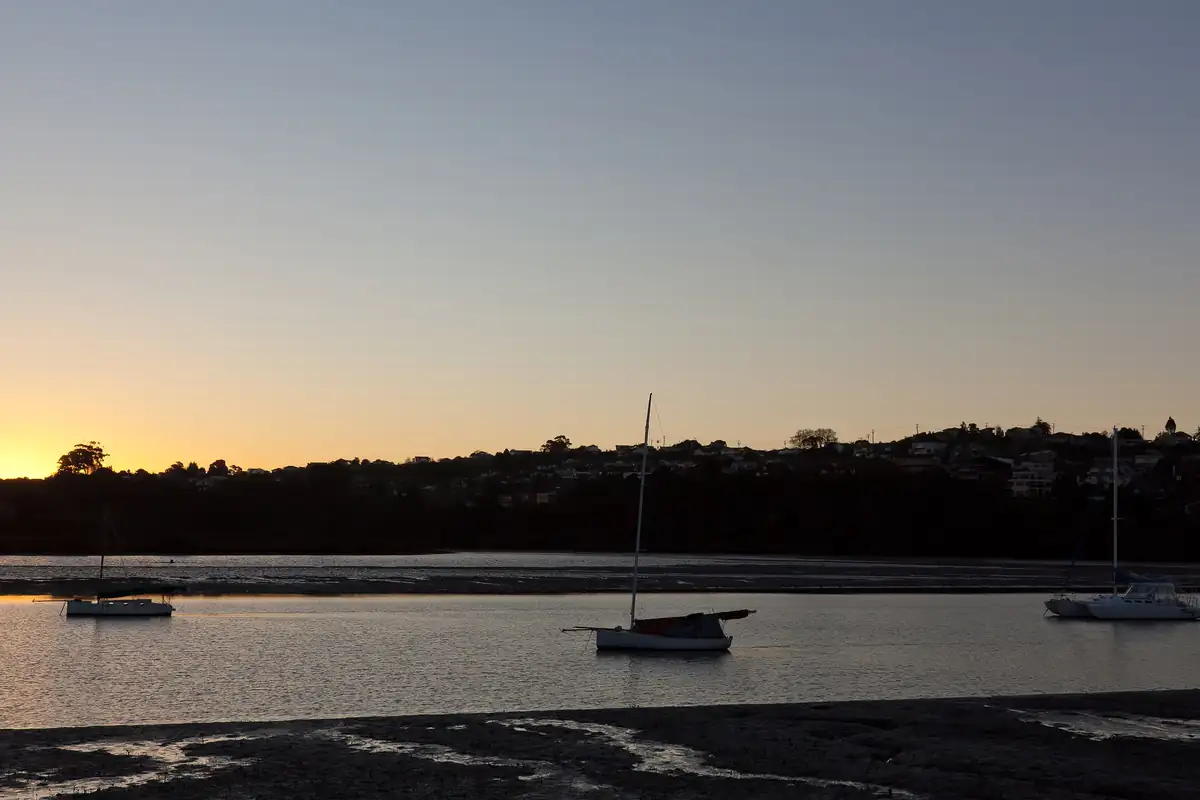
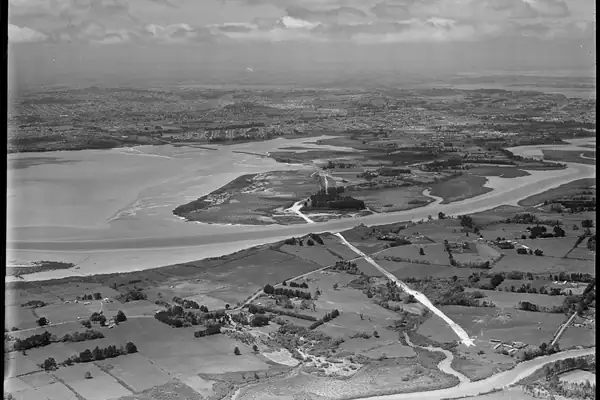
The peninsula is about four kilometres long and two wide, ringed by the Waitemata Harbour. It is made of Waitemata sandstone under softer alluvial soil. Te Wai-o-Pareira / Henderson Creek bounds the west and the Whau River the east. A saltmarsh on the eastern side links to the Motu Manawa (Pollen Island) Marine Reserve.
Before European farming, Te Kawerau a Maki had two kainga at the mouth of Henderson Creek, Orukuwai and Orangihina. Their names live on in the peninsula's Maori name and in the big coastal park.
Coastal margins like these have sunny banks, scrub and driftwood, which suit ground nests. Walkers on the shore paths often find a nest by disturbing it. If you see wasps rising from one spot, step back and note where it is. Ground nests explains the signs.
Ramlea Park and the motorway years
After its brickworks closed, Te Atatu was farmland producing dairy, pigs, poultry and fruit. Suburban building began with the Ramlea Park Estate in the early 1950s. The motorway split the area in two, and the southern part was named Te Atatu South in 1961. Within ten years it went from rural to suburban.

One builder, Neil Homes, put up much of the peninsula's early housing. Te Atatu South has a wider mix, including larger family homes from its more affluent 1970s and 1980s. These houses have roof spaces, soffits and subfloor vents that German wasps use. A busy roof nest usually shows by February. Roof nests covers what to watch for.
Older homes here are often weatherboard or brick on a timber frame, with a subfloor. Wasps that get under the house can reach the floor framing and sometimes the wall cavity. If you hear a faint scratching in a wall, read wall nests before you seal anything.
Harbourview-Orangihina Park
Harbourview-Orangihina Park covers 85 hectares of the peninsula coast. It holds anti-aircraft gun emplacements from 1943, built to protect the Hobsonville air base. Part is leased by the Te Atatu Pony Club, and the Semadeni residence is the peninsula's oldest building. The council plans native planting and new walking and cycling paths.
Rough grass, old earthworks and scrub make good nest country. A nest in the park is public land, so report it to Auckland Council rather than deal with it yourself. Keep dogs on a lead near a busy hole. Horses can also stir up a ground nest in a paddock.
- BuiltMostly 1950s to 1970s
- WaterHenderson Creek, Whau River
- Big parkHarbourview-Orangihina, 85 ha
- Watch forGround nests by the coast
Townhouses from the late 2010s
Changes to the Auckland Unitary Plan brought intensive townhouse building to the peninsula in the late 2010s. Shared driveways, common walls and small gardens are now common. A nest in a shared wall or a common hedge raises the question of who books the visit. In a body corporate, it is usually the body corporate. Rental property nests covers tenants and landlords.
Building continues. Construction of a Te Atatu busway station was due to begin in 2024. An urban marae is also planned at Harbourview-Orangihina Park. Building sites, stacked materials and fresh planting all give queens new places to start nests in spring.
Orchards, vineyards and flower farms
Before the houses, Te Atatu South was vineyards, poultry farms, orchards and flower farms. Vineyards ran along Te Atatu, McLeod and Edmonton Roads. If your section still has an old fruit tree, fallen fruit draws wasps in late summer. Pick it up often, and check the tree for a nest before you prune.
The peninsula itself was cleared for farms in the 1880s and sold as the Henderson Mill Estate in 1894. Later it grew dairy, pigs, poultry and small orchards for the city. If your section has a big old shelter tree or hedgerow, check it for paper wasp combs in summer.
Creek paths, parks and sports grounds
The Twin Streams Pathway follows Henderson Creek on the west side, and the Te Whau Pathway runs along the east. Te Atatu South Park, McLeod Park and Jack Colvin Park all have sports fields. Tui Glen Reserve is close by. Clubs and schools with a nest near a field should keep players clear and book a visit. Schools, clubs and businesses are handled the same way. Upstream, see Henderson.
Schools on both sides of the motorway
Peninsula Primary, Matipo Primary and Rutherford Primary serve the peninsula. Te Atatu South has Flanshaw Road, Tirimoana, Freyberg Community and Edmonton Primary schools, and Rutherford College sits just north of the boundary. School grounds next to the coast and creek paths see plenty of wasps in late summer.
A school office that finds a nest should keep children away from the area and note where the wasps go in. Visits can be timed for after class, so the grounds are clear while the pest controller works.
Te Atatu price guide
Most nests in Te Atatu fall inside the Auckland guide range of about $120 to $350 per nest. A paper wasp comb on a fence is at the low end. A German wasp nest in a roof space, a creek bank or a shared wall can cost more. These figures are a guide only. The written quote from the pest controller sets the price. The cost guide explains what changes it.
Booking a visit in Te Atatu
Tell us the street, whether it is the peninsula or Te Atatu South, and where the wasps go in. Mention a shared driveway or a body corporate. A local technician comes to you with a written quote. Use the form on the quote page or call 09 942 7069. If someone has been stung or the nest is by a door, read urgent wasp help.
Every other suburb is covered as well. Go back to the Waspari front page for prices, timing and the booking steps.
Questions people ask
There is a nest in the long grass at Harbourview-Orangihina. Who do I call?
The park is public land, so report the nest to Auckland Council. Note the nearest path or landmark and keep people and dogs away until it is dealt with.
Our townhouse shares a wall with next door. Whose nest is it?
If the nest is in a shared wall or common area, the body corporate usually arranges the visit. Tell the manager, and tell your neighbour so nobody blocks the entrance hole.
Do you cover Henderson, Lincoln and Massey too?
Yes. We take requests from both Te Atatu suburbs and the rest of West Auckland.
Sources we checked
Last reviewed 2026-11-05.