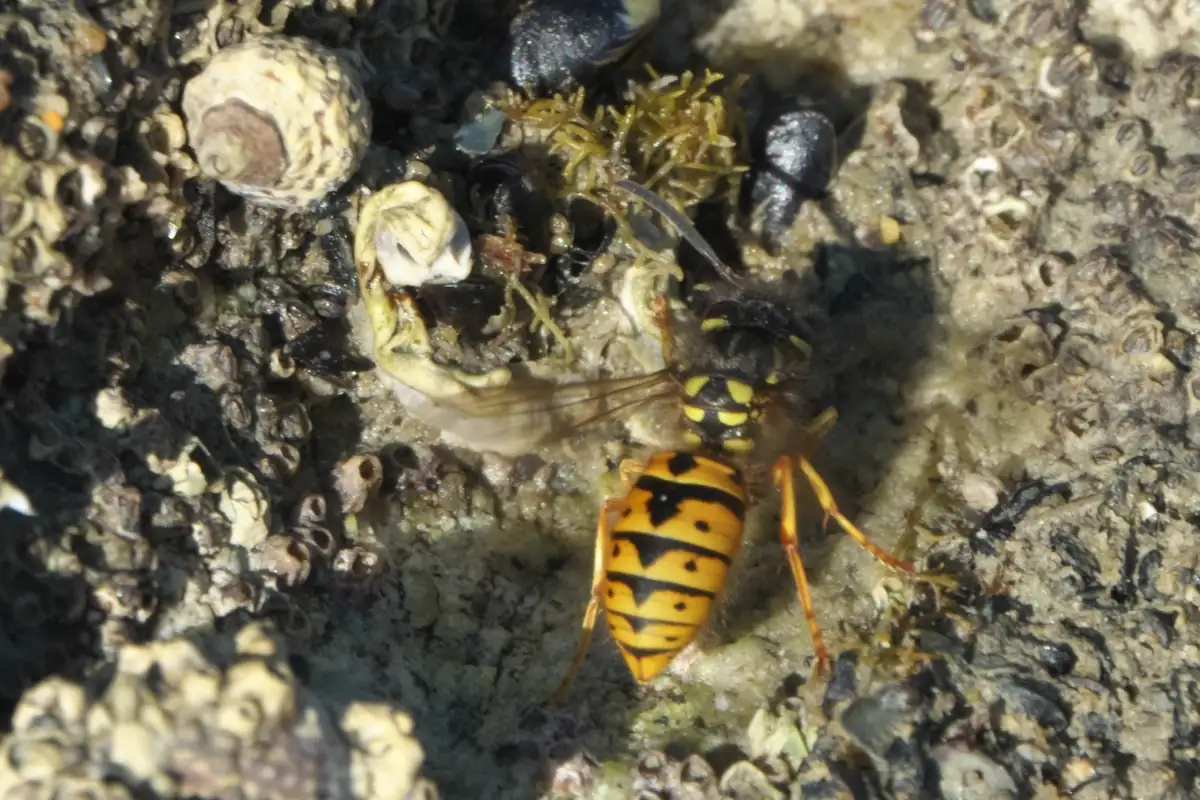
Straight answerPick a warm, still afternoon and watch from a safe distance. Wasps returning to a nest fly in a straight, steady line, low to the ground or to the roofline, and disappear into one spot. Follow that line a few steps at a time and look for a hole, a gap or a paper ball with a stream of wasps going in and out. Stop at about 5 to 7 metres once you see it.
When is the best time to look?
Mid to late afternoon on a warm, dry, still day. That is when traffic is busiest and easiest to see. Avoid early morning, cold days and rain, when wasps are quiet. Late summer is easiest because nests are big, but in spring and early summer the nest is smaller and the job safer, so it is worth looking early.
Follow the flight line
Foraging wasps fly back to the nest in a fairly straight line. Stand where you see most wasps, such as a fruit tree, a bin or the barbecue, and watch which way the loaded ones leave. Move a few metres along that line and watch again. Repeat. Sunlight behind the wasps makes them easier to see.
Where to look around a section
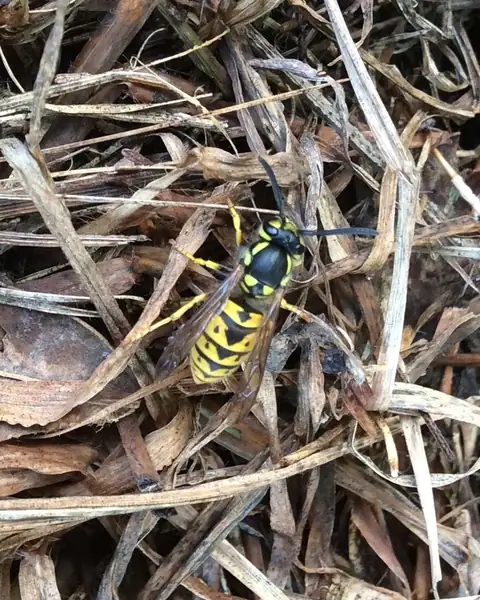
German and common wasps usually nest underground, often in a sunny bank, but also in roof spaces, wall cavities, under floors, decks and in hollow trees. Paper wasps hang open combs in hedges, shrubs, under eaves and on fences. Check the places below.
- Sunny banks, rock walls and the edges of lawns: ground nest holes
- Under decks, steps and garden sheds: ground or cavity nests
- Roofline, soffits, vents and gaps in weatherboards: roof and wall nests
- Hedges, flax, shrubs and fence rails: paper wasp combs
- Compost bins, wood piles and old tyres: sheltered hollows
What the nest entrance looks like
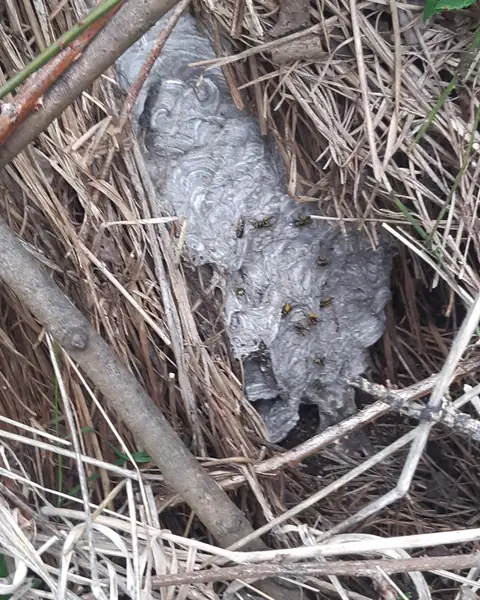
A ground nest entrance is often just a hole the width of a coin, with a steady stream of wasps going in and out and sometimes a little bare soil around it. A roof or wall nest shows as wasps going into one gap in the cladding, a vent or under a roofing iron. A paper wasp comb is visible: a grey umbrella of open cells.
Stay safe while you look
Wear long sleeves, long trousers and closed shoes. Keep children and pets inside. Don't poke sticks into holes, lift boards, shake shrubs or stand right over an entrance. Landcare says disturbed workers attack within about 7 metres, especially moving targets. If wasps start coming at you, walk away quickly and keep going. Anyone allergic should leave the search to someone else.
What to note for a quote
Once you know where it is, back off and note the details: where the entrance is, how high, whether it is a hole, a gap or an open comb, roughly how busy, and what is near it. A photo from a distance helps. That is enough for a pest controller to plan the visit. Send it to us, and see what it costs.
Can't find it?
Wasps forage a long way, so the nest may be next door or in a reserve. If it is on council land, report it to Auckland Council on 09 301 0101. If it is on a neighbour's property, talk to them. If you still can't find it, a pest controller can look, though a search with no nest found may still be charged.
Got a nest at your own place rather than a question? See Waspari for what a visit involves and what it tends to cost.
Questions people ask
How far from the nest do wasps forage?
It varies, but lots of wasps in one spot usually means a nest nearby. If you see a steady stream heading one way, the nest is along that line.
Should I look for a wasp nest at night?
Not to find it: at night there is no traffic to follow. Night is when some people treat a nest they have already found, because the wasps are home.
What if the wasps are going into my neighbour's place?
Tell your neighbour where you see them going. The nest is the property owner's to deal with. If it is in a council reserve, report it to Auckland Council.
Sources we checked
- Life cycle of a wasp (Manaaki Whenua Landcare Research)
- Wasp control (Manaaki Whenua Landcare Research)
- Wasp FAQ (Manaaki Whenua Landcare Research)
- Wasps (Department of Conservation)
- How to control pest animals (Auckland Council)
Last reviewed 2026-11-05.