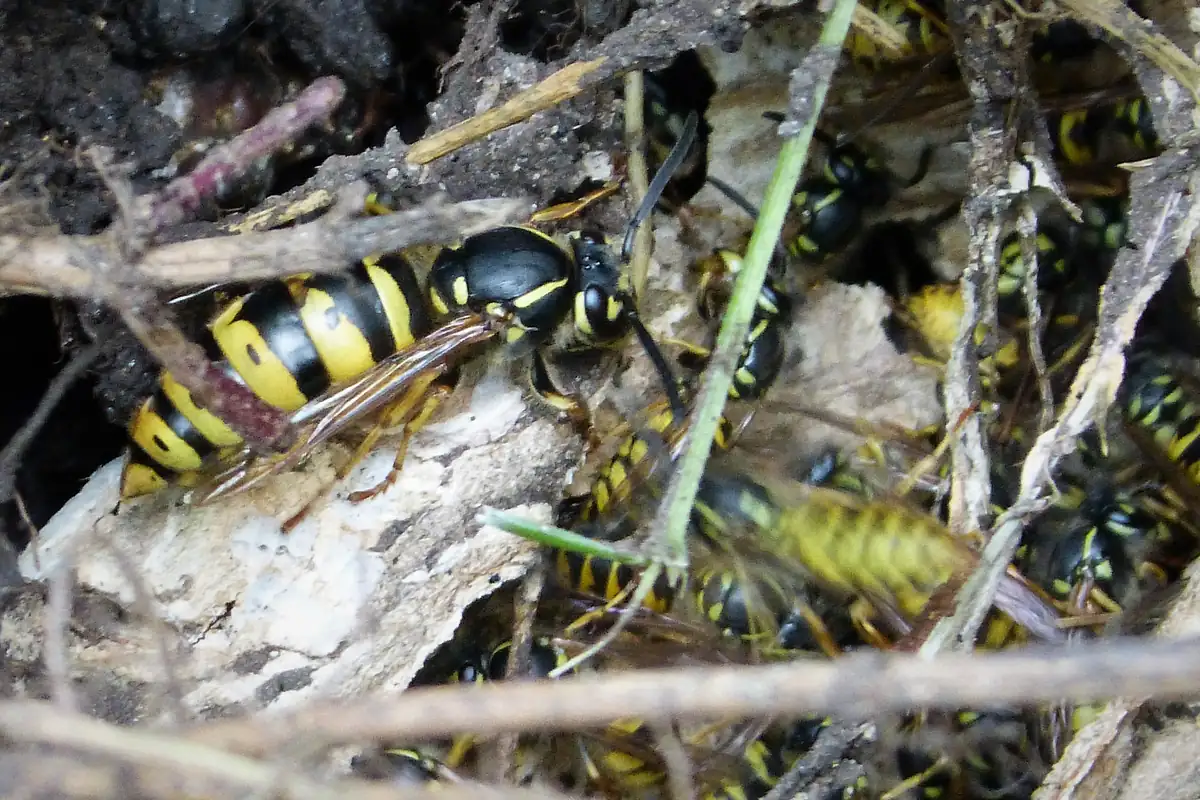

Straight answerIn spring, the big, slow wasps you see around the garden, the shed and the eaves are queens. Each one has come out of hibernation and is looking for a nest site, or has just started one. A spring nest is the size of a golf ball or an orange, with one queen and a few workers. Found now, it is far easier and safer to deal with than the same nest in February.
Why are there big wasps in spring?
Mated queens spend winter hidden somewhere dark and dry: under bark, in wood piles, in sheds, roof spaces and wall linings. As the weather warms they wake, feed on nectar and look for a nest site. Landcare Research says a spring queen may fly up to about 70 km searching. Queens reach about 20 mm, roughly twice the size of a worker.
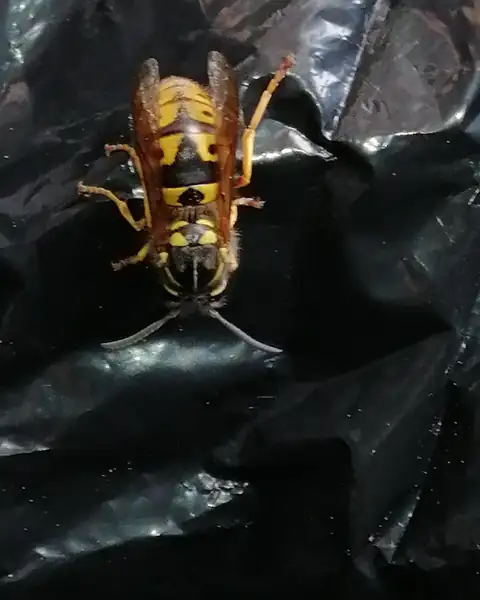
What a queen does when she starts a nest
She builds alone. The queen chews wood fibre into paper, makes a small stalk and a few cells, lays an egg in each and wraps them in a paper shell. She forages for food herself until the first workers hatch. Landcare says each egg takes about 4 to 7 weeks to become an adult. Once she has 5 to 7 workers she stays inside, laying.
What does a starter nest look like?
A German or common wasp starter nest is a small, grey or brown paper ball, golf-ball to orange sized, often with the entrance at the bottom. Look under eaves, in sheds, in compost bins, in bird boxes, under decks and at holes in banks. A paper wasp starter is a tiny open comb on a stalk, the size of a walnut, with a single queen guarding it. See what a wasp nest looks like.
Why spring is the easiest time
Numbers. A spring nest has one queen and a handful of workers. By late summer a German wasp nest can hold thousands, and Landcare says an average nest produces 11,000 to 13,000 workers and 1,000 to 2,000 new queens in a season. Each of those queens can start a nest next spring. Treating a nest early stops that before it starts.
- October to December: queen and first workers, nest small
- January to March: rapid growth, thousands of workers
- Late summer to autumn: males and new queens raised
- Late autumn: most nests die; new queens hibernate
Should you swat a spring queen?
A queen inside the house can be guided out or swatted; one queen fewer is one nest fewer. Outside, don't chase her. Watch where she goes instead. A queen flying repeatedly to the same gap in the eaves, the same shed corner or the same hole in a bank has a nest there. Note it and have it checked.
The hornet check
Yellow-legged hornet queens were found on Auckland's North Shore after the 2025 finds, and DOC notes any survivors would be queens coming out of hibernation in spring. A hornet is 2 to 3 cm, mostly dark, with yellow leg tips and an orange band. If you think you see one, don't touch it. Photograph it if safe and call MPI on 0800 80 99 66. More: paper wasp or hornet.
Getting a spring nest dealt with
A small nest in an easy spot is at the low end of the published Auckland range, about $120 to $350 per nest. The price depends on access more than size: a starter nest inside a roof or wall still needs the entrance found. It is a guide; your price is confirmed in writing. How removal works.
Got a nest at your own place rather than a question? See Waspari for what a visit involves and what it tends to cost.
Questions people ask
Do wasp queens sting?
Yes, queens and workers can both sting. A queen out on her own in spring is not defending a big nest, so she is unlikely to attack, but don't handle her.
Is it worth killing a single queen in spring?
One queen is one potential nest, so a queen indoors is worth dealing with. Outdoors, it is more useful to watch where she flies and find the starter nest.
When do wasp queens come out in Auckland?
Queens wake as the weather warms in spring, roughly from September, with the most activity in October and November. Mild Auckland winters mean some come out early, and some nests survive winter altogether.
Sources we checked
- Life cycle of a wasp (Manaaki Whenua Landcare Research)
- Wasp FAQ (Manaaki Whenua Landcare Research)
- Wasp control (Manaaki Whenua Landcare Research)
- Yellow-legged hornet (Department of Conservation)
- Yellow-legged hornet flyer (Oct 2025) (Ministry for Primary Industries)
Last reviewed 2026-11-05.