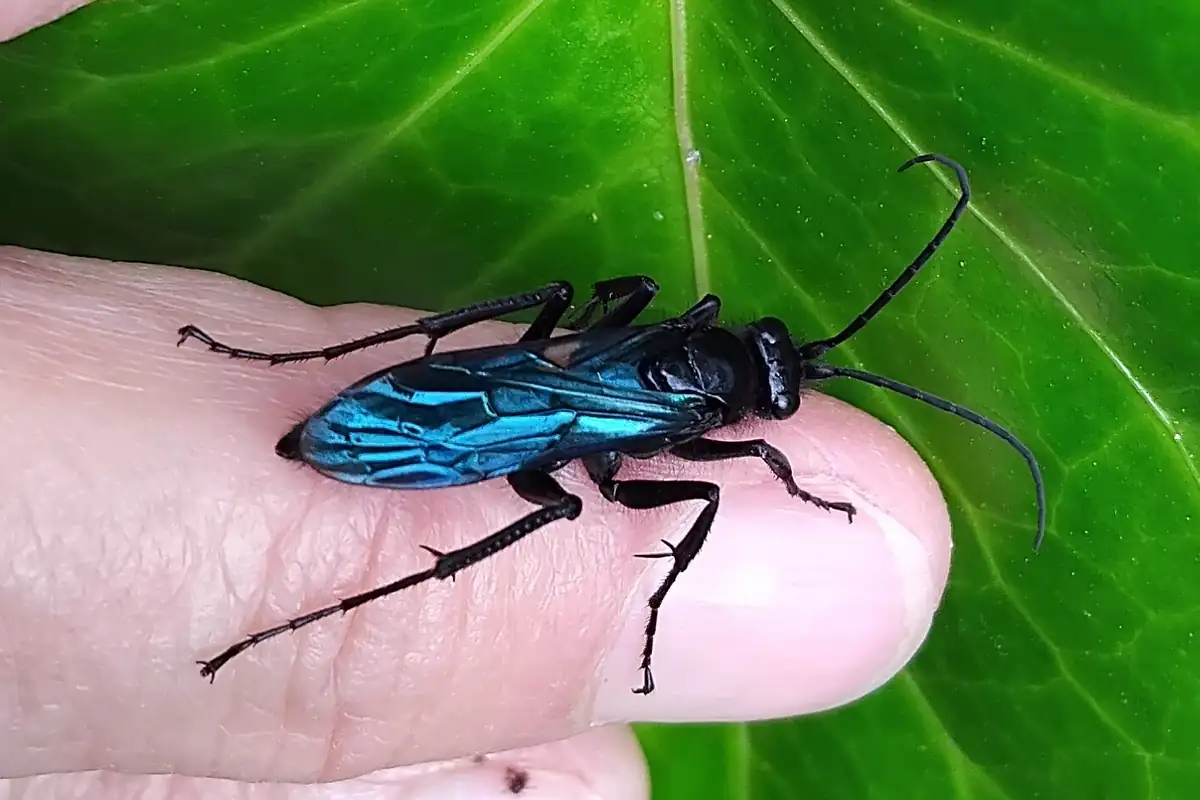
Straight answerNew Zealand has no native social wasps. Every native wasp lives alone, hunts spiders or caterpillars, and never builds a big paper nest. DOC says native wasps have never become a nuisance. The black wasps, orange wasps and mud-building wasps people find around Auckland houses are usually natives, and they can be left alone. The nest problems are introduced German, common and paper wasps.
How is a native wasp different from a pest wasp?
Natives are solitary: one female does all the work, with no workers and no colony to defend. Pest wasps are social, living in nests of hundreds or thousands. Natives rarely sting people and only when handled. Most are black, dark blue or orange, without the bright yellow and black bands of a German wasp.
The black wasp: spider-hunting wasps
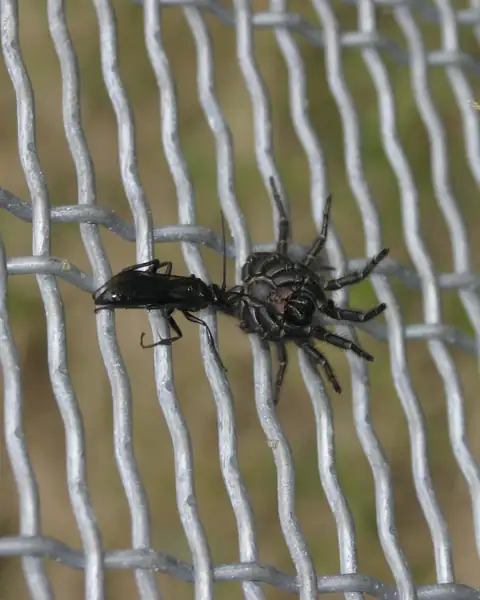
That fast, glossy black wasp running over the lawn or a path, flicking its wings, is usually a spider-hunting wasp. The best known is the large black hunting wasp, ngaro wiwi, which hunts big spiders such as tunnelweb spiders. Landcare Research says spider-hunting wasps reach about 20 mm, are all solitary, and hunt spiders to feed their young. Some species are native, some introduced.
The orange wasp: ichneumons
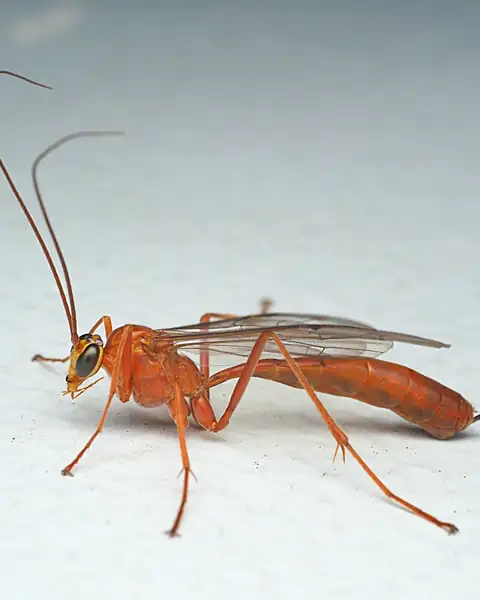
A slim orange wasp with long legs, often at a lit window at night, is likely an ichneumon such as the orange ichneumonid. It is about 20 mm and lays its eggs in moth caterpillars, which it uses as food for its young. Ichneumons don't live in colonies and don't build nests. They are on your side in the vegetable garden.
The mud builder: mason wasps
The native mason wasp is fully black and builds small mud cells in curtain folds, keyholes, window tracks and cracks, each stocked with paralysed spiders. You might hear it whine while it works the mud. It is harmless unless grabbed. Mason wasps has the detail on those mud nests.
So which wasps are the problem?
Five introduced social wasps are established in New Zealand: the German wasp, the common wasp and three paper wasps. These build the nests that sting people, rob hives and strip honeydew from native forest. If you see a stream of yellow and black wasps, or an open grey comb, it is one of these. Identify your wasp, then see nest removal if needed.
- German and common wasps: yellow and black, covered nests, thousands of workers
- Asian and Australian paper wasps: slim, long dangling legs, open combs
- Native wasps: solitary, black or orange, no paper nest
Should you ever deal with a native wasp?
No. There is nothing to treat, because there is no colony. A single wasp inside can be guided out with a glass and card. A mason wasp's mud cell on a window frame can be brushed off once it is empty if you don't want it there. Leave the hunters alone in the garden; they help control spiders and caterpillars.
Got a nest at your own place rather than a question? See wasp nest removal in Auckland for what a visit involves and what it tends to cost.
Questions people ask
Are black wasps in New Zealand dangerous?
Usually not. Most black wasps are solitary spider hunters that sting only if handled. They don't build nests or defend an area. Leave them alone and they will leave you alone.
Does New Zealand have any native social wasps?
No. Every native wasp is solitary. All the social wasps that build big nests, German, common and paper wasps, were introduced.
What is the big orange wasp at my window at night?
Most likely an ichneumon, which is attracted to lights. It is a parasite of caterpillars, not a nest builder.
Sources we checked
- Wasps (Department of Conservation)
- Spider-hunting wasps (Manaaki Whenua Landcare Research)
- Orange ichneumonid wasp (Manaaki Whenua Landcare Research)
- Mason wasp (Manaaki Whenua Landcare Research)
- Large black hunting wasp, ngaro wiwi (Entomological Society of NZ, Bug of the Year)
- Vespula wasps (Manaaki Whenua Landcare Research)
Last reviewed 2026-11-05.