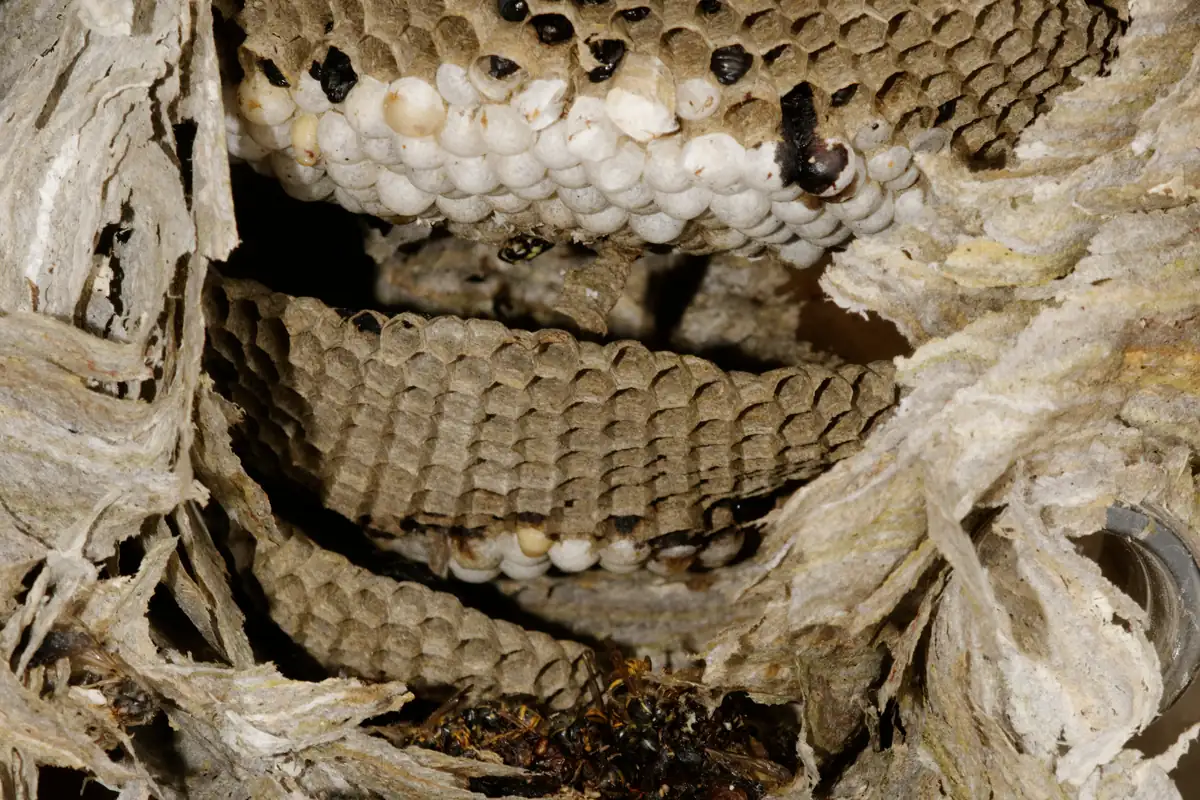

Straight answerA German or common wasp nest starts in spring as a golf-ball sized paper shell built by one queen. It grows slowly until the first workers hatch, then fast through summer as tiers of comb are added underneath. By late summer a typical nest is the size of a soccer ball. It raises males and new queens, then usually dies in late autumn. About 1 in 10 German wasp nests survive winter and keep growing.
Spring: the queen alone
From about September to November, the queen builds a small stalk, a few cells and a paper envelope, and raises the first brood on her own. Landcare says each egg takes about 4 to 7 weeks to become an adult (egg, larva, pupa, adult). At this stage the nest is golf-ball to orange sized and quiet. It is the easiest time to find and deal with it.
Early summer: the first workers take over
Once 5 to 7 workers have hatched, the queen stops foraging and only lays eggs. Workers do everything else: building, hunting, feeding larvae and guarding. Growth speeds up sharply. Workers live about 12 to 22 days, so the nest is constantly replacing them while adding more. Traffic at the entrance becomes obvious.
January to March: fast growth
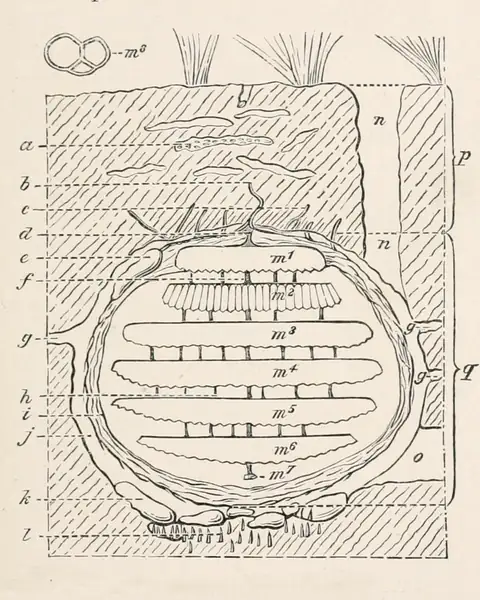
This is when Auckland nests get big and searches for wasp nest removal peak. New comb tiers are hung below older ones, and the paper envelope is enlarged around them. Landcare says nests can have up to about 20 tiers and run at about 31 degrees inside. An average nest raises 11,000 to 13,000 workers in a season. Disturbed nests send defenders out to about 7 metres.

Late summer and autumn: males and new queens
Late in the season the nest switches to raising males, then new queens about two weeks later. Landcare says an average nest produces 1,000 to 2,000 new queens. They mate, and the mated queens leave to find somewhere to hibernate. Professor Beggs at the University of Auckland points to January and February as a good time to kill nests, before they release new queens.

Winter: die-off, or not
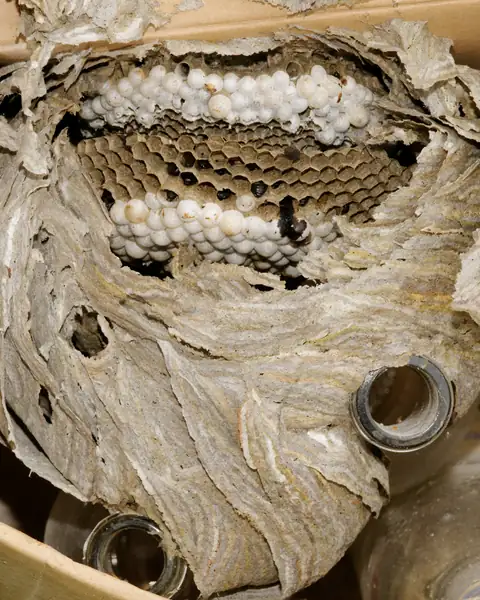
Most nests die in late autumn as the old queen fails and workers die off. An empty nest is not reused. But Landcare says about 10% of German wasp nests in New Zealand survive winter. With a big workforce from the start of spring, and several new queens laying, they can grow huge in their second year. Common wasp nests survive winter only occasionally.
How big can a nest get?
A one-season nest is usually about the size of a soccer ball. Overwintered nests are another matter. DOC records the world's largest wasp nest at Waimauku, Auckland, almost 4 m tall. In January 2025 a multi-year nest about 1.6 m tall with over 200,000 wasps was treated on a Karaka farm. These are rare, but they start the same way.
- Spring: golf ball to orange, one queen
- Midsummer: football sized, a few thousand workers
- Late summer: soccer ball and up, peak numbers
- Second year (rare): can reach a metre or more
What this means for you
The earlier a nest is found, the smaller and simpler the job. A nest found in February is at its most defensive, so leave it to a pest controller. Prices are set by access more than size: the published Auckland range is about $120 to $350 per nest, as a guide. See German wasp nest removal and wasp season in Auckland.
Got a nest at your own place rather than a question? See help with a wasp nest anywhere in Auckland for what a visit involves and what it tends to cost.
Questions people ask
How fast does a wasp nest grow?
Slowly for the first 4 to 7 weeks while the queen raises her first workers, then quickly. By February a nest started in October can hold thousands of wasps.
Do paper wasp nests grow the same way?
Paper wasp combs grow outward as a single open layer and stay much smaller, holding tens to a few hundred wasps. They don't build stacked tiers inside a shell.
Why are some years worse for wasps?
Wasp numbers go in boom and bust cycles. The University of Auckland linked the 2024 to 2025 boom to a long, hot, dry spell. Wet springs and cold snaps knock numbers back.
Sources we checked
- Life cycle of a wasp (Manaaki Whenua Landcare Research)
- Wasp FAQ (Manaaki Whenua Landcare Research)
- Wasps (Department of Conservation)
- Wasp numbers explode after long hot summer (2025) (University of Auckland)
- Monster nest of over 200,000 wasps destroyed (Jan 2025) (Newstalk ZB)
Last reviewed 2026-11-17.