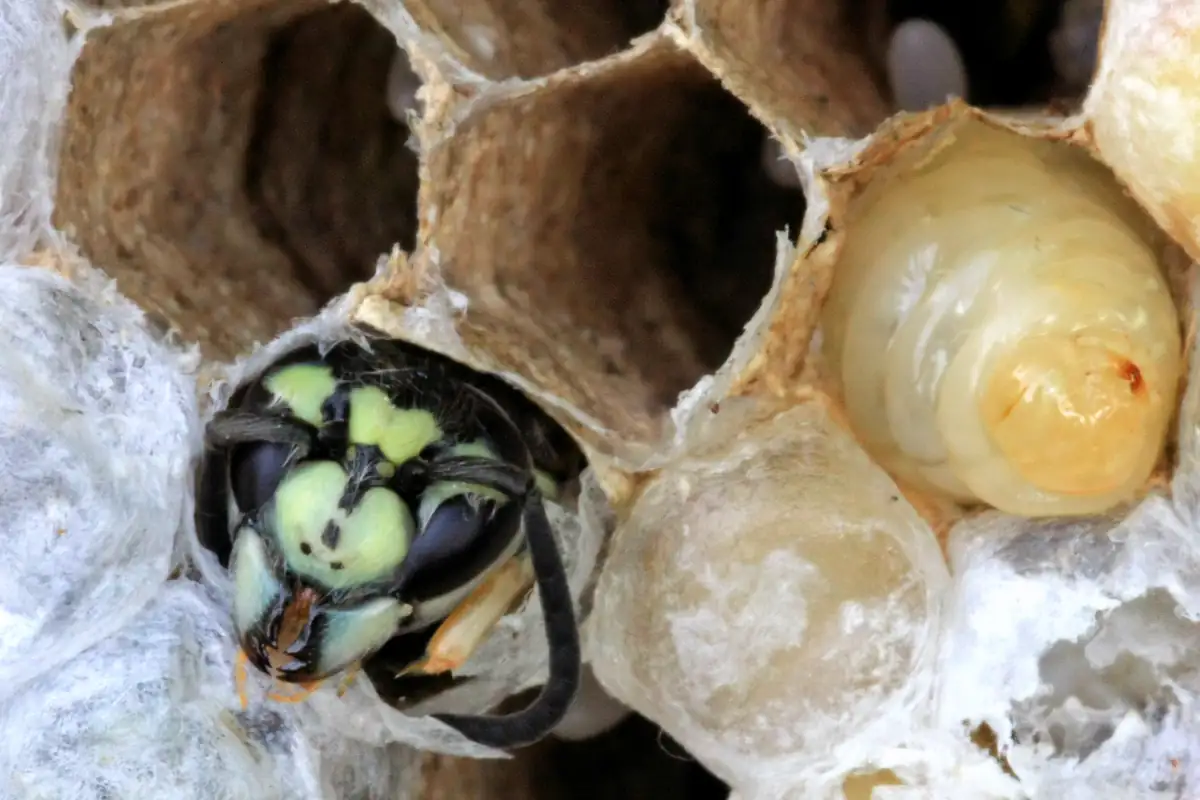

Straight answerA German or common wasp goes through four stages: egg, larva, pupa and adult. The queen lays one egg in each paper cell. It hatches in 5 to 8 days. The larva is fed for about 15 days, then seals itself in and pupates for 8 to 18 days. Egg to adult takes about 28 to 48 days. Most workers then live less than three weeks.
What are the stages of a wasp's life cycle?
There are four: egg, larva, pupa and adult. Wasps change shape completely between them, like butterflies and beetles do. A larva looks nothing like the adult. It is a soft white grub with no legs, and it never leaves its cell. Manaaki Whenua Landcare Research gives the timings below for German and common wasps.
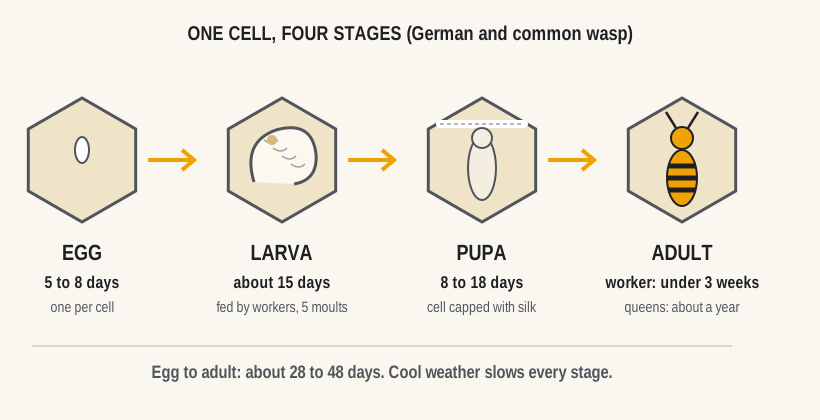
| Stage | How long | What happens |
|---|---|---|
| Egg | 5 to 8 days | The queen lays a single egg in each paper cell. |
| Larva | About 15 days | Workers feed it chewed insects. It moults five times and fills the cell. |
| Pupa | 8 to 18 days | The larva spins a silk cap over the cell and turns into an adult inside. |
| Adult | Workers: under 3 weeks | It chews out of the cell. Its first few days are spent inside, feeding larvae. |
Add the stages up and one wasp takes about 28 to 48 days to grow. Landcare says the weather decides where in that range it falls. A warm nest raises wasps faster. The nest core runs at about 31 °C, kept warm by pockets of air trapped in the paper walls.
The egg: one to a cell
Each cell gets one egg, laid by the queen. In spring she does everything alone. She chews wood fibre into paper, builds the first few cells and lays in them. Then she hunts insects and gathers sugar to feed the first larvae herself. The eggs are tiny and white.
Once five to seven workers are flying, the queen stops going out. From then on she stays inside and lays eggs for the rest of her life. That is the point where a nest takes off. Spring queens and starter nests covers that early stage.
The larva: the hungry stage
A wasp larva is a fat, legless grub that is fed by workers for about 15 days. It moults five times as it grows. Larvae need protein, so workers hunt insects and take scraps of dead animals, chew them up and carry them home. A larva cannot leave its cell, so everything it eats is brought to it.
Landcare describes a trade between larvae and workers. Workers digest very little of what they catch. They pass the food to the larvae, and the larvae give back a drop of sugary, part-digested liquid. That swap feeds the adults and holds the colony together. It is also why baits and dusts carried in by workers reach the young. What wasps eat explains the diet through the year.
The pupa: sealed in
When a larva is full grown, it spins a silk cap over the mouth of its cell and pupates. This takes 8 to 18 days. Inside, the grub turns into an adult with legs, wings and a sting. From outside, you see rows of white domed caps on the comb. When the adult is ready, it chews through the cap and climbs out.
While one batch pupates, the nest keeps building. New layers of comb are added underneath the old ones, so the nest grows downwards. Landcare says a nest can reach 20 layers, held apart by short paper pillars. The gaps are just high enough for workers to squeeze in and feed the larvae.
The adult: workers, drones and queens
A new adult is one of three kinds. Workers are sterile females and make up nearly all of a nest. Drones are males, raised only in late summer and autumn. Queens are fertile females raised in larger cells near the bottom of the nest. All three come from the same four stages. A queen is simply raised in a bigger cell.
A worker's jobs change as it ages. For its first three or four days it stays in and feeds larvae. Then it fetches water and wood fibre to build. Next it forages for food, mostly within a few hundred metres of the nest, sometimes up to a kilometre. Late in life it guards the entrance.
- Days 1 to 4: nurse, feeding larvae inside the nest
- Next: builder, carrying water and chewed wood fibre
- Then: forager, hunting insects and collecting sugar
- Last: guard at the entrance, the wasps that meet you first
If the queen dies, workers develop eggs of their own within a couple of weeks. Their eggs are never fertilised, so they only ever hatch into males. A queenless nest can carry on for a while, but it is winding down.
How long does a wasp live?
Not long, unless it is a queen. Landcare says nearly all worker wasps die before they are three weeks old. Drones live only through late summer and autumn, long enough to mate. A queen born in autumn mates, hibernates through winter, starts a nest in spring and lays until the nest dies. That makes her life about a year, by far the longest in the colony.
Short-lived workers explain a lot about summer wasps. A big nest is replacing its whole workforce every few weeks. A nest at its peak in late summer can hold thousands of workers, all of them only days or weeks old.
Where the stages fit in the nest's year
The four stages repeat all season inside one nest. In spring the queen raises a few workers alone. Through summer the nest raises worker after worker and grows fast. In late summer and autumn it switches to drones, then new queens, about two weeks later. Landcare says an average nest produces 1,000 to 2,000 queens a season.
Drones gather around trees and high points and mate with queens in flight. Mated queens then find a dark, dry spot to hibernate, antennae tucked under and jaws clamped onto the surface. Most nests die off in late autumn. In New Zealand about 10% of German wasp nests survive the winter and keep growing. How a wasp nest grows walks through the year month by month.
The paper wasp life cycle, in plain view
Paper wasps go through the same four stages. The difference is that you can watch it. Their combs are a single layer of open cells with no paper shell, so eggs, white larvae and silk-capped pupae are all visible from below. Colonies stay small, with hundreds of wasps at most, against thousands in a German wasp nest.
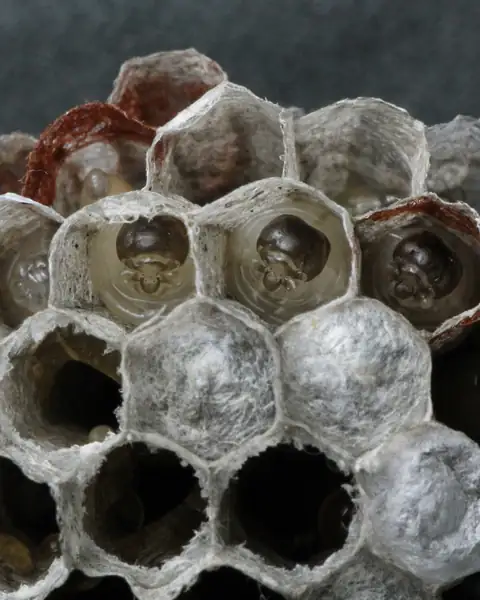
Asian paper wasps hang their combs from a short stalk on eaves, fences, hedges and shrubs. DOC puts a full nest at about the size of a pear. We have not found a New Zealand source that times each paper wasp stage, so we don't give day counts for them here. Paper wasps covers what they look like and where they nest.
What is a wasp's biggest enemy?
In Europe, where German and common wasps come from, a nest is home to a crowd of parasites, scavengers and predators. In New Zealand that crowd is missing. DOC says the wasps have no natural predators here. With mild winters and plenty of food, that is why New Zealand has some of the highest wasp densities recorded.
So the things that kill most wasps here are not animals. Landcare names two. Cold, wet springs cut the number of nests that get going. And rival queens fight over new nests, often for a long time. A large share of founding nests, where the queen still works alone, fail for these reasons.
Natural enemies tried as biocontrol
Scientists have spent decades looking for a natural enemy that could cut wasp numbers here without harming honey bees or native insects. None has worked so far. One parasite was released and barely settled, and the others are still being studied. Finding and safety-testing an agent takes years. Landcare lists these candidates:
- Sphecophaga vesparum, a 5 to 8 mm parasitic wasp that lays eggs on wasp larvae and pupae. Released at many sites, but known to have settled at only two (Ashley Forest in Canterbury and Pelorus Bridge in Marlborough), with no sign it reduces wasp numbers.
- A mite, Pneumolaelaps niutirani, found riding on queen wasps in Canterbury. Here it has been seen feeding on wasp larvae and may spread viruses. Its use as a control is still being studied.
- Volucella hoverflies, large European flies whose larvae live in wasp nests and can eat larvae and pupae late in the season. Proposed, but not fully assessed.
- Diseases. About 50 fungi, 12 bacteria and a handful of nematodes, protozoa and viruses have been recorded from wasp nests, but few are proven to kill wasps.
Wasps defend themselves well against disease. Landcare notes there are antibiotics in their saliva and venom, and workers remove sick nestmates quickly. Even a good agent would only ever thin wasps out. It would never wipe them out, because it needs wasps to survive.
What the life cycle means for a nest near your house
Timing matters more than anything. A spring nest has one queen and a handful of cells. By late summer the same nest can hold thousands of workers, all guarding brood. In autumn it releases new queens, and each one can start a nest of its own next spring. Dealing with a nest before autumn stops that next round.
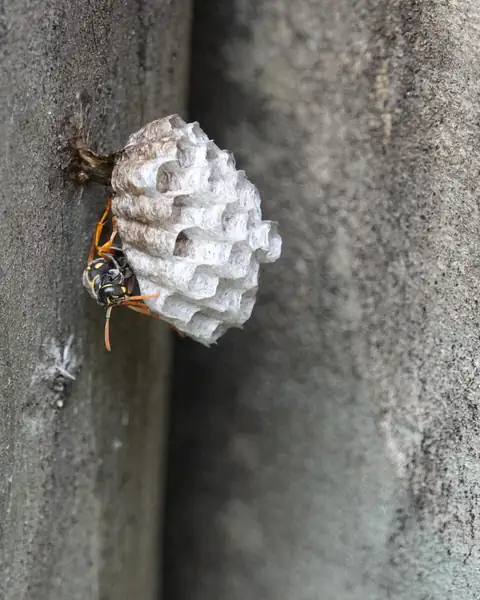
Quiet in winter does not always mean dead in Auckland. One German wasp nest in ten survives the winter here, and those are the ones that grow huge. Is the wasp nest still active? shows how to check from a safe distance.
Covered nests in the ground, walls and roof spaces are the ones not to tackle yourself. A local technician visits with a written quote before any work starts. How nest removal works.
Got a nest at your own place rather than a question? See Waspari's Auckland nest visits for what a visit involves and what it tends to cost.
Questions people ask
How long does it take a wasp to grow from egg to adult?
About 28 to 48 days for German and common wasps, according to Landcare Research. The egg hatches in 5 to 8 days, the larva feeds for about 15 days, and the pupa takes 8 to 18 days. Warm weather speeds it up.
How long do wasps live?
Worker wasps rarely live more than three weeks. Drones live only through late summer and autumn. A queen lives about a year: born in autumn, she hibernates, starts a nest in spring and lays eggs until the nest dies.
What is a wasp's worst enemy in New Zealand?
No animal keeps wasps in check here. DOC says they have no natural predators in New Zealand. Cold, wet springs and fights between queens kill many young nests. Beyond that, the main check is people controlling nests and using targeted baits.
Do all wasps die in winter?
Workers and drones die off and most nests are dead by late autumn. Mated queens survive by hibernating. In New Zealand about 10% of German wasp nests survive winter and keep growing, which is how giant nests form.
Sources we checked
- Life cycle of a wasp (Manaaki Whenua Landcare Research)
- Wasp control (Manaaki Whenua Landcare Research)
- Wasp biocontrol updates (Manaaki Whenua Landcare Research)
- Wasps (Department of Conservation)
- Asian paper wasp (Manaaki Whenua Landcare Research)
- Asian paper wasp (Hawke's Bay Regional Council)
Last reviewed 2026-11-17.